
About
One Person. One Mission.
The Last Watch Project is the work of a single researcher, archivist, and storyteller — driven by the belief that no service member should be forgotten.
How It Started
One Footlocker. One Question. One Mission.
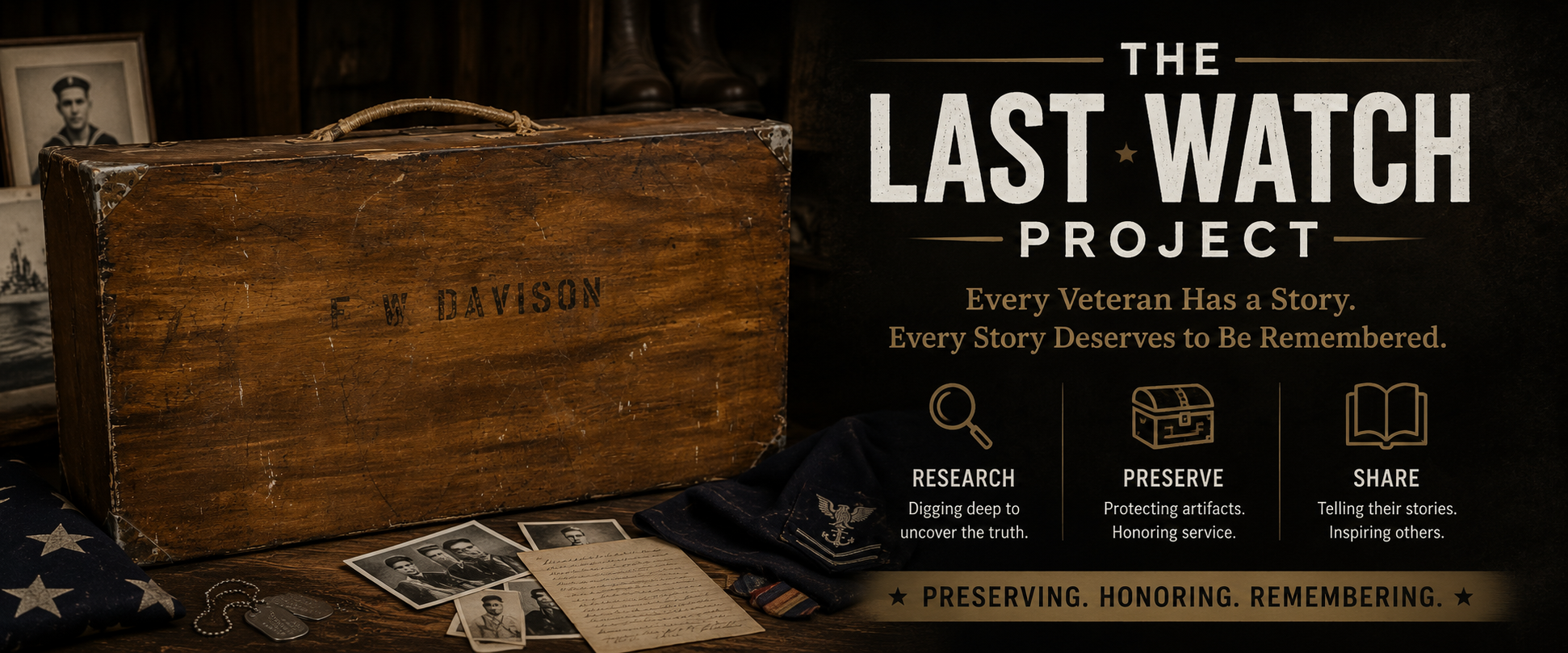
The Last Watch Project began not with a plan, but with a question: whose is this? A Navy footlocker turned up at an estate sale — stenciled with markings, nearly empty, and about to disappear into a landfill. Someone bought it. Someone opened it. Inside were only two things: the stencil kit used to label the footlocker, and a Western Union telegram dated 1945 — sent by his wife in Baltimore to Treasure Island, California.
What followed was months of research — military records, census data, ship logs, family archives — until a name emerged: Francis W. Davison, Chief Motor Machinist's Mate, United States Navy, World War II. He had served. He had come home. And he had been forgotten.
That experience made one thing clear: this was not a one-time project. Across the country, the belongings of veterans are quietly disappearing — sold off, thrown away, or left to decay in storage units and attic boxes. The Last Watch Project exists to stop that from happening, one artifact at a time.

Who I Am
One Researcher. All of It.
The Last Watch Project is not a museum, a government agency, or an organization with a staff directory. It is one person — researching, archiving, writing, and publishing — doing the work that needs to be done. Every project is handled with the same rigor and respect, from the first lead to the final published story.
Research-Driven
Every claim is backed by documentation. Military records, census data, ship logs, newspaper archives, school records, and family sources are all cross-referenced before any story is published.
Family-Centered
Many projects begin with a family — people who have stories but no documents, or documents but no context. Connecting families to the history of their veterans is at the heart of this work.
Openly Archived
Every completed story is published publicly and archived permanently. History belongs to everyone — not just those who can afford a museum ticket.
The Name
Why "The Last Watch"?
In naval tradition, the "watch" is a period of duty — a shift of vigilance, of keeping guard while others rest. Every sailor stands their watch. Every soldier pulls their duty. And when their service ends, someone else takes over.
The Last Watch Project is that final handoff. When a veteran's belongings are scattered and their story is at risk of being lost forever, I stand the last watch — preserving what remains, honoring what was given, and making sure the record does not go dark.
Join the Watch
Whether you have an artifact to submit, a tip to share, or simply want to support the work — I want to hear from you.