
Project · #003
Edward Dominic Indigaro
Chief Boatswain's Mate, United States Navy
January 10, 1903 – January 6, 1980
Every Veteran Has a Story. Every Story Deserves to Be Remembered.
Veteran Profile
Name
Edward Dominic Indigaro
Born
January 10, 1903 · Boston, Massachusetts
Died
January 6, 1980 · Covina, California · Age 76
Branch
United States Navy
Conflicts
World War II · Korean War
Highest Rating
Chief Boatswain's Mate (CBM)
Ships
USS Semmes (AG-24) · USS Utina (ATF-163) · USS Borie (DD-704) · USS Stormes (DD-780) · USS Corry (DD-817) · USS Owen (DD-536)
Service
January 12, 1929 – February 1, 1959 (Retired List)
Burial
Oakdale Memorial Park · Glendora, California
Early Life
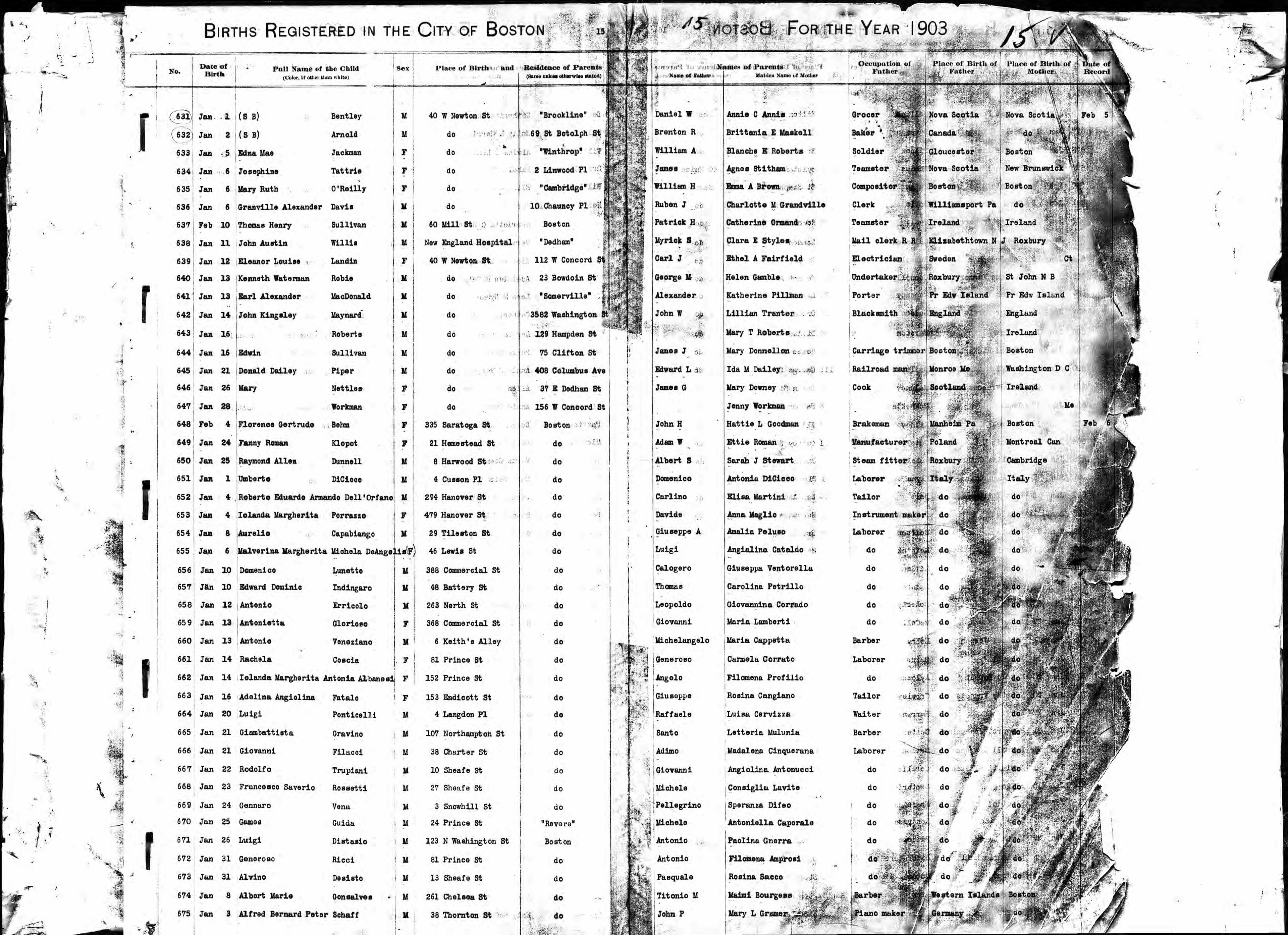
Edward Dominic Indigaro was born on January 10, 1903, in Boston, Massachusetts, the son of Tomasso Indigaro — who later used the name Thomas in America — and Carolina (née Precillo) Indigaro. Both of Edward's parents were born in Italy and immigrated to the United States in 1901, establishing their family in America shortly before Edward's birth.
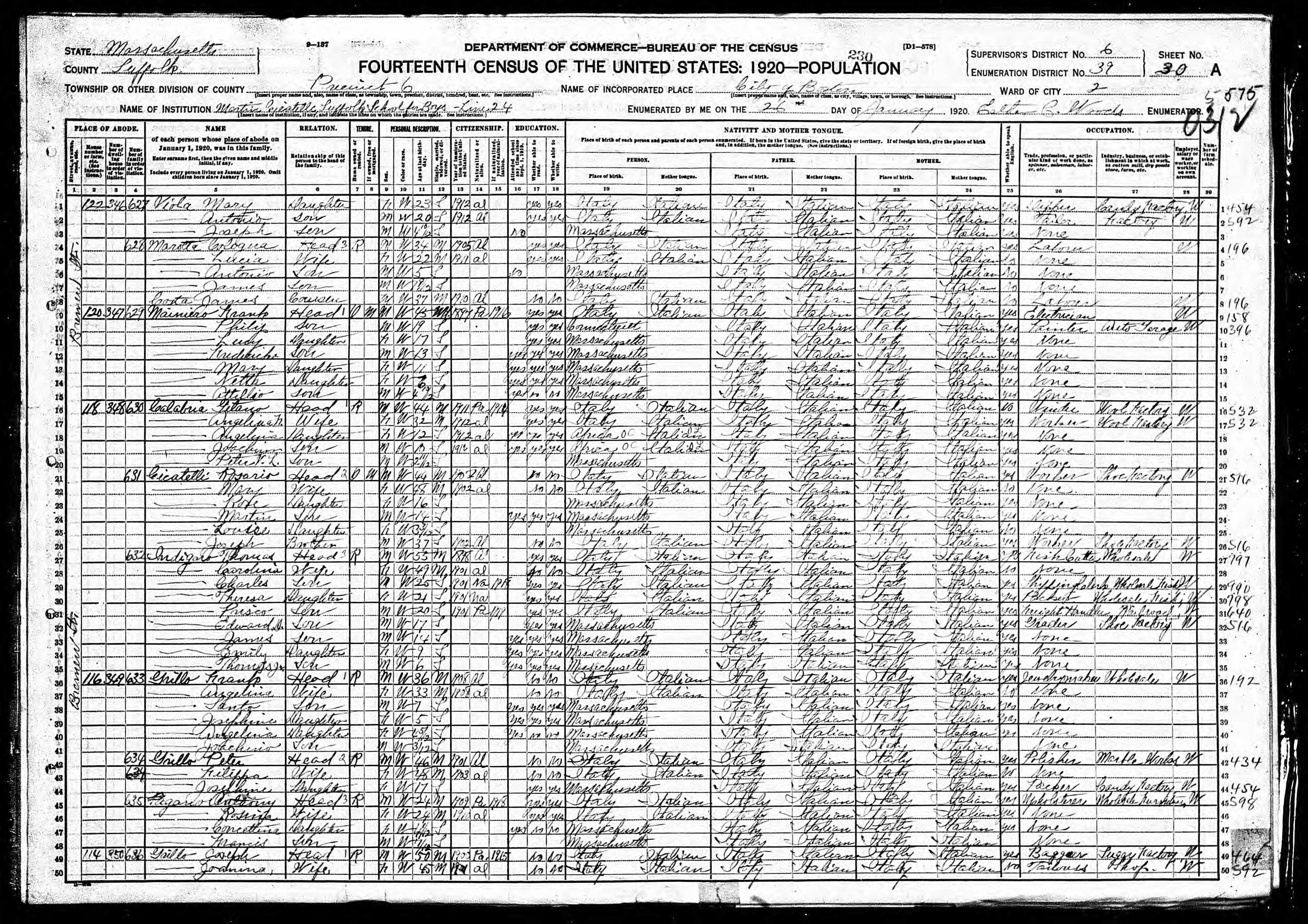
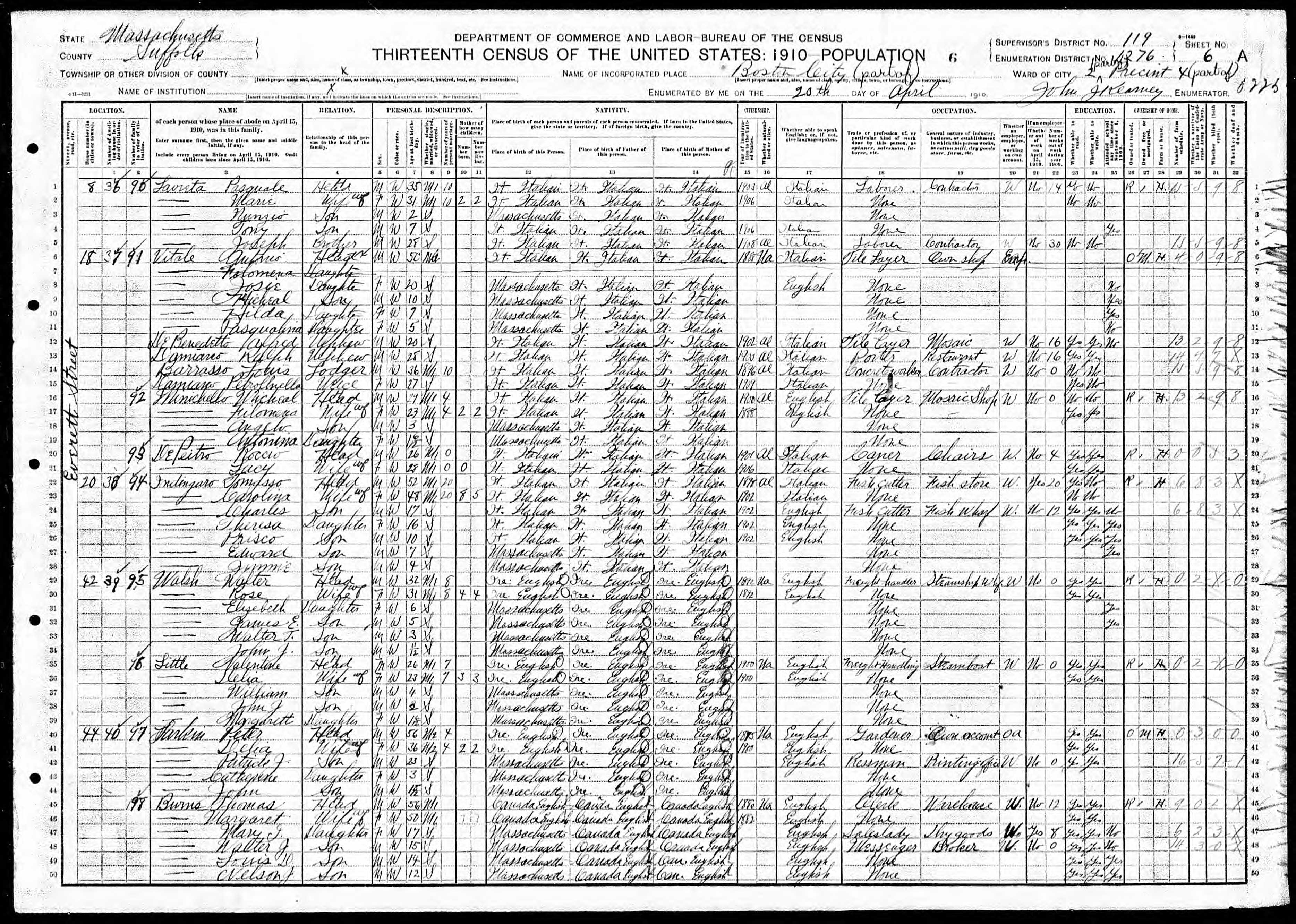
Edward grew up as part of a large Italian-American family alongside his siblings Charles, Theresa, Prisco, James, Emily, and Thomas Jr. Census records provide a glimpse into the working-class household in which Edward spent his childhood and young adulthood. His father worked as a fish cutter in the wholesale fish industry, a trade that also employed members of the family.
By 1920, Edward, then approximately seventeen years old, was employed as a grader in a shoe factory. Other members of the Indigaro family found work in the fish trade, railroad freight service, manufacturing, and other occupations common to working-class Boston during the period. Edward's own path, however, would eventually take him away from Boston and toward a life at sea.
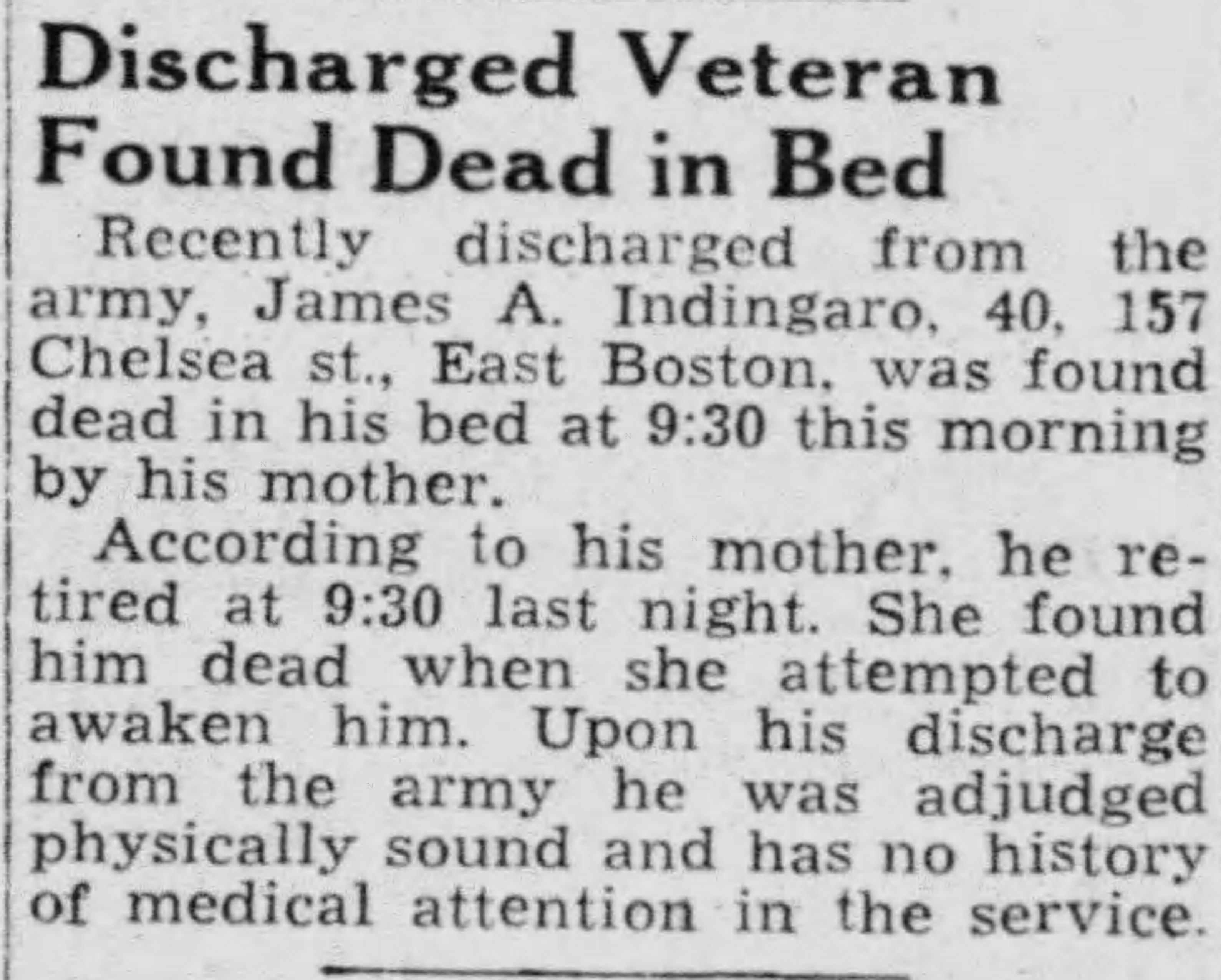
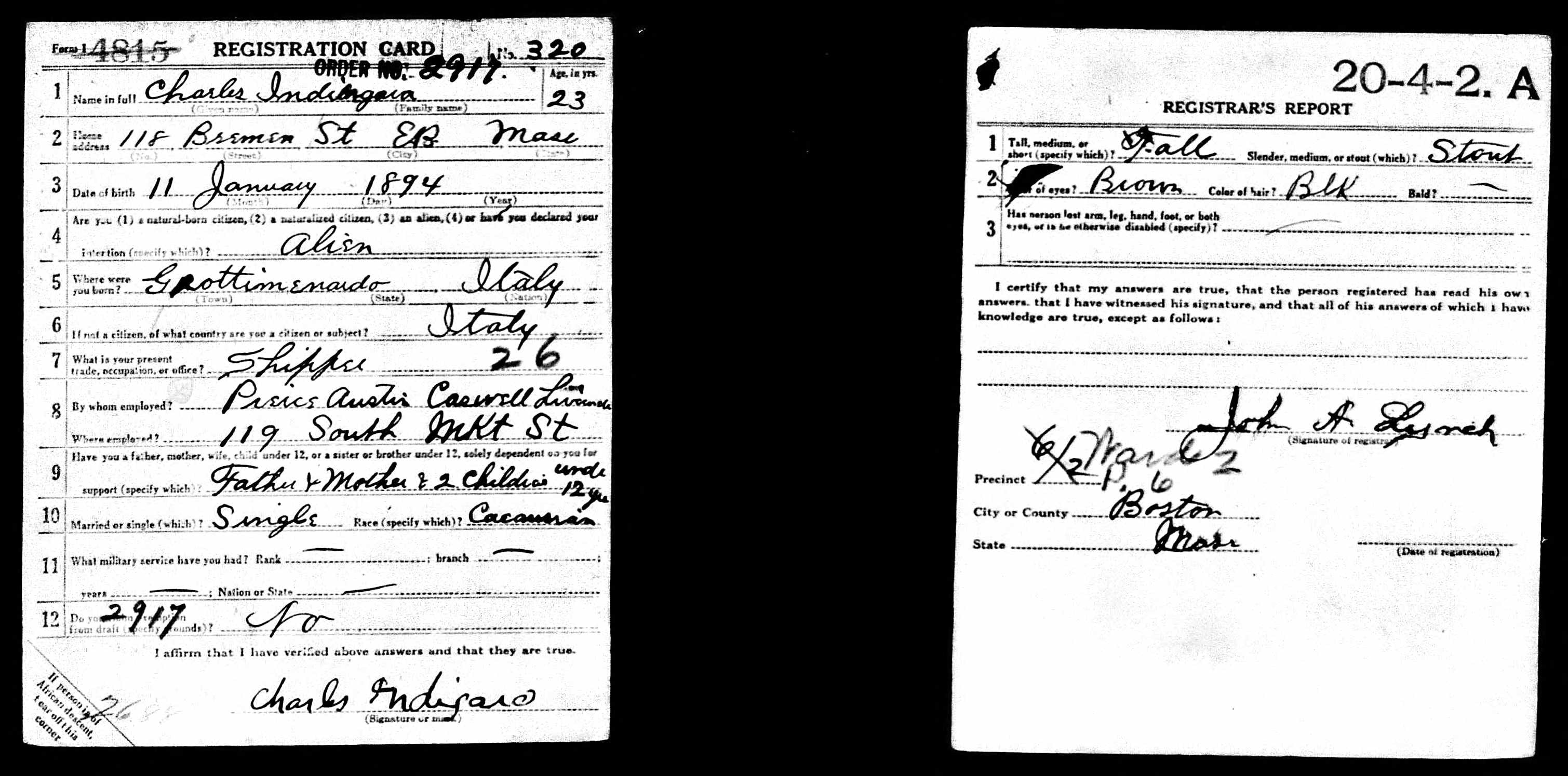
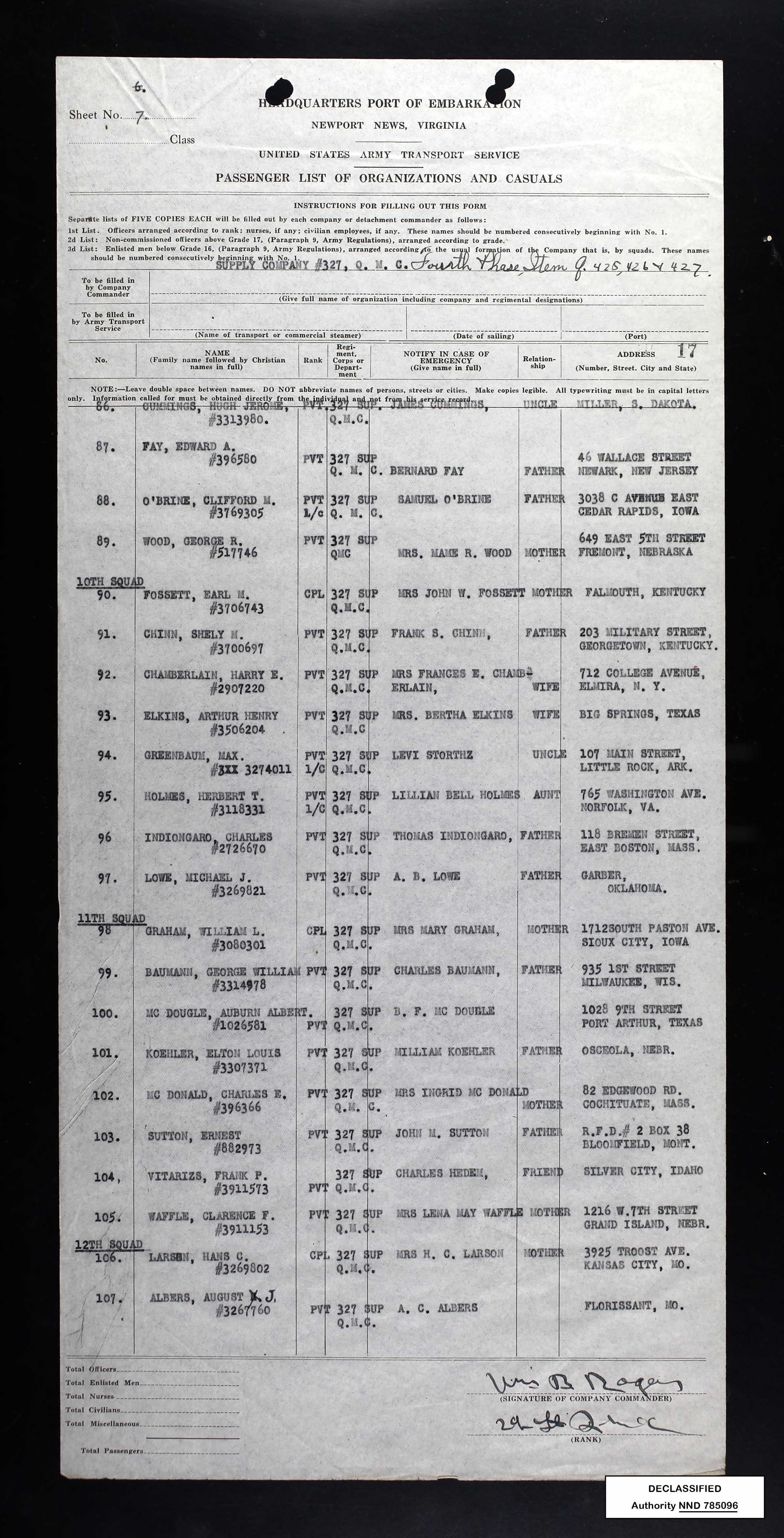
Military service was also part of the Indigaro family. Edward's brother, Private Charles Indigaro, served during World War I, while his brother Jimmy "James" Indigaro later served as a corporal, making Edward one of several Indigaro brothers who answered the call to military service.
Family
Edward was one of seven children born to Thomas and Carolina Indigaro. His siblings — Charles, Theresa, Prisco, James, Emily, and Thomas Jr. — grew up together in the working-class Italian-American community of East Boston. The family maintained close ties throughout their lives, and Edward's connection to his siblings and their families is documented in newspaper accounts, census records, and oral history.
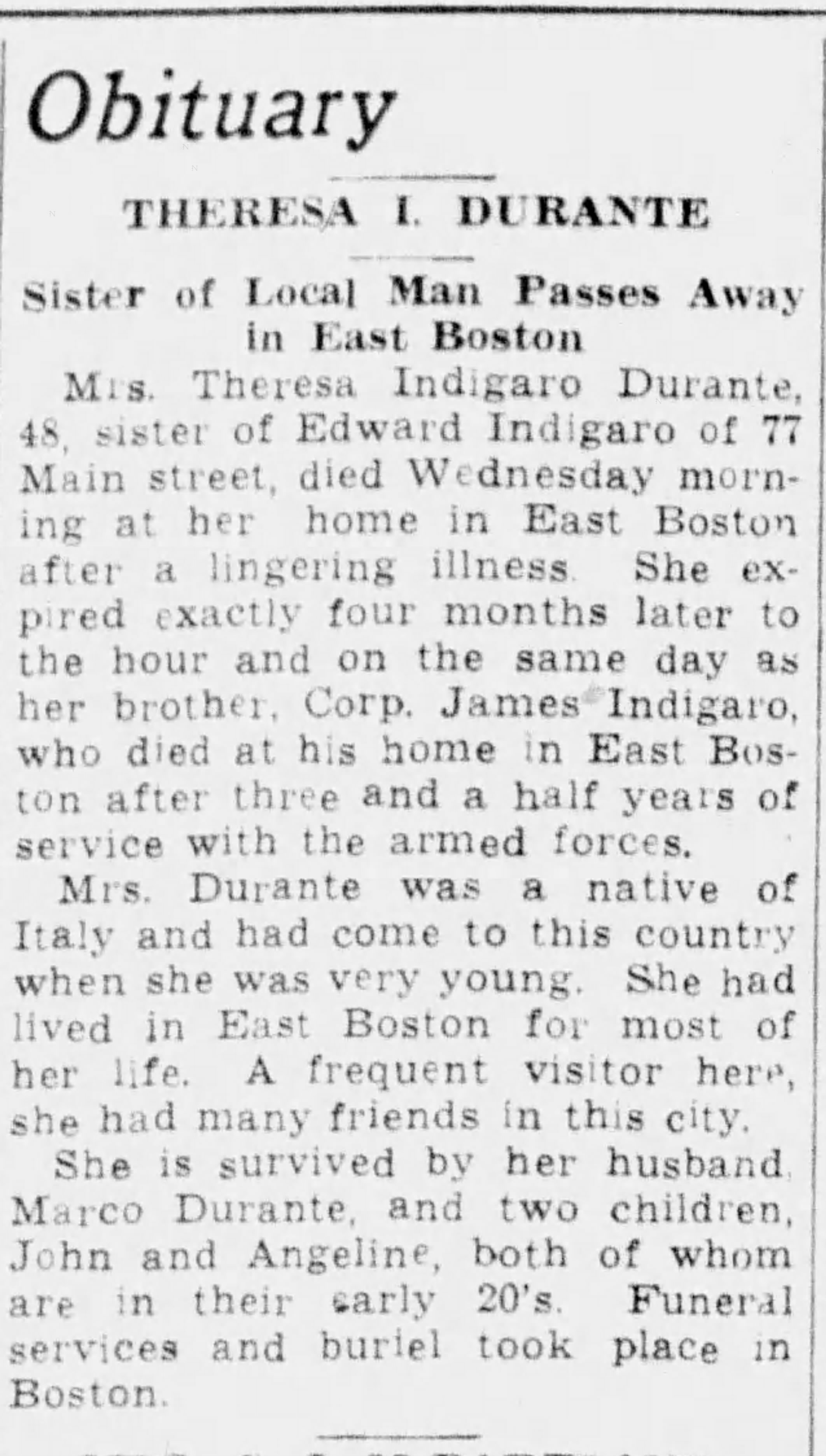
His sister Theresa Indigaro married Marco Durante and settled in East Boston, where she raised two children, John and Angeline. She died on August 5, 1946, at the age of forty-eight, following a lingering illness. The obituary published in The Day noted a remarkable coincidence: Theresa died exactly four months to the hour and on the same day of the week as their brother James, who had died after three and a half years of service with the armed forces. Theresa's obituary identified Edward by name and address — 77 Main Street, New London — placing him firmly in the record at the time of her death.
Early Naval Career
On January 12, 1929, just two days after his twenty-sixth birthday, Edward enlisted in the United States Navy in Boston, Massachusetts. His enlistment began a relationship with the Navy that would ultimately span approximately three decades and encompass the prewar fleet, World War II, the postwar Navy, the Fleet Reserve, and his recall during the Korean War era.
The ships and stations on which Edward served during 1929 through 1937 remain the largest unresolved portion of his naval career. Further research into his early personnel records and pre-1938 muster rolls may eventually reveal these assignments.
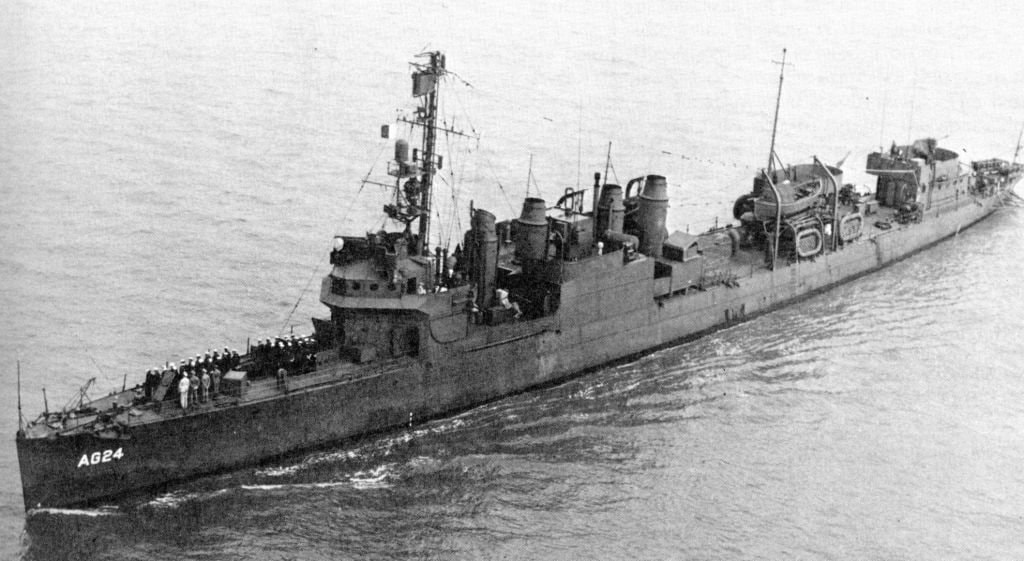
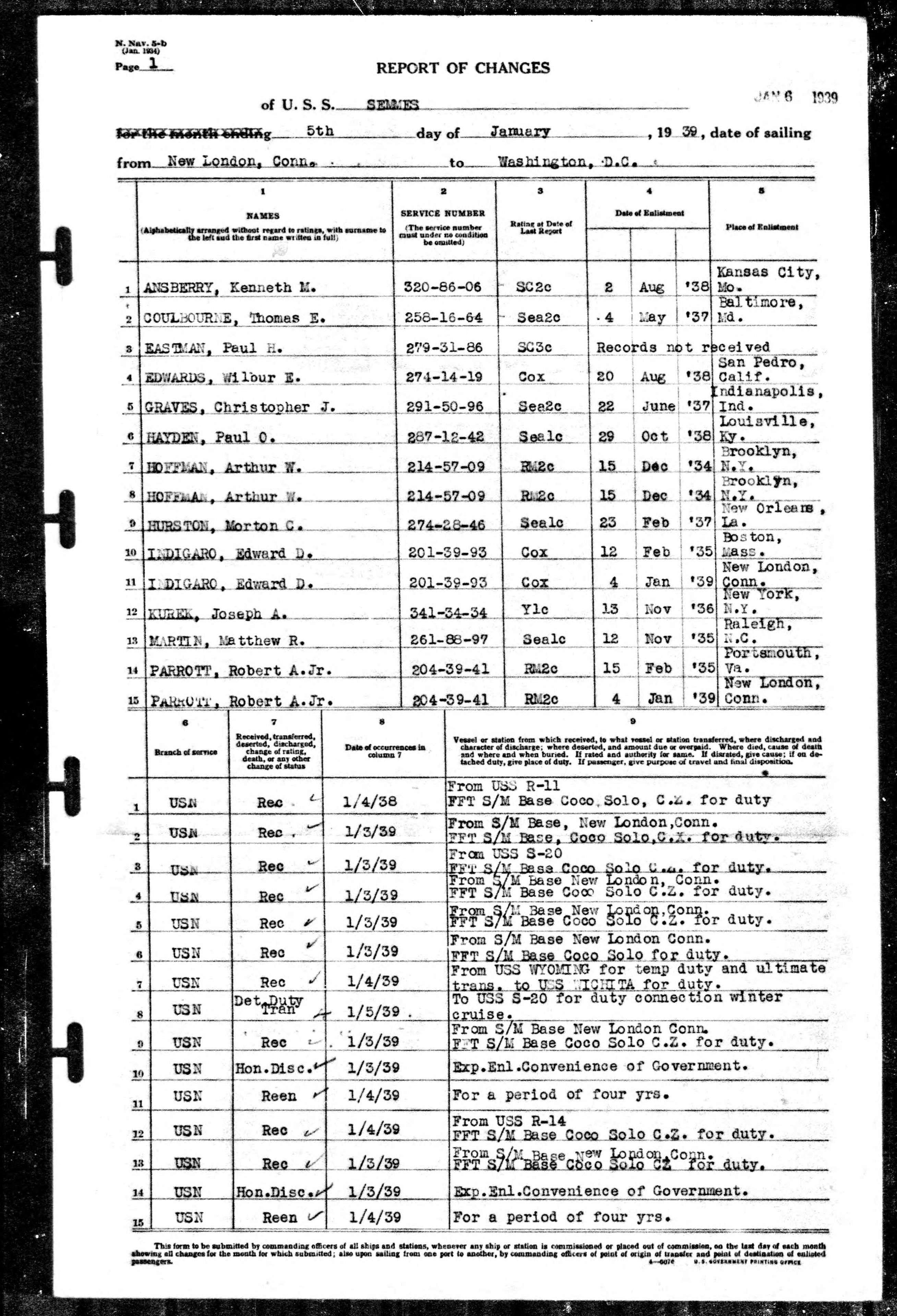
On January 3, 1938, Edward was honorably discharged at the expiration of an enlistment. His separation from the Navy lasted only a day. On January 4, 1938, he reenlisted at New London, Connecticut, with records soon placing him aboard USS Semmes (AG-24). By March 28, 1938, Edward was documented aboard Semmes, where his rating was recorded as Coxswain (COX).
The Coxswain rating belonged to the Navy's traditional deck and seamanship community and represented an important stage in Edward's progression through the Boatswain's Mate ratings. His duties would have centered upon the traditional work of the deck force, including small-boat operations, line handling, anchoring and mooring, rigging, deck maintenance, watches, and seamanship.
Edward steadily advanced through the deck ratings during the following years. On August 16, 1940, he advanced to Boatswain's Mate Second Class (BM2). Sometime between June and September 1942, Edward advanced again, and by September muster records, he is identified as Boatswain's Mate First Class (BM1). His BM1 rating is again confirmed on a December 31, 1942 muster.
Marriage to Hazel
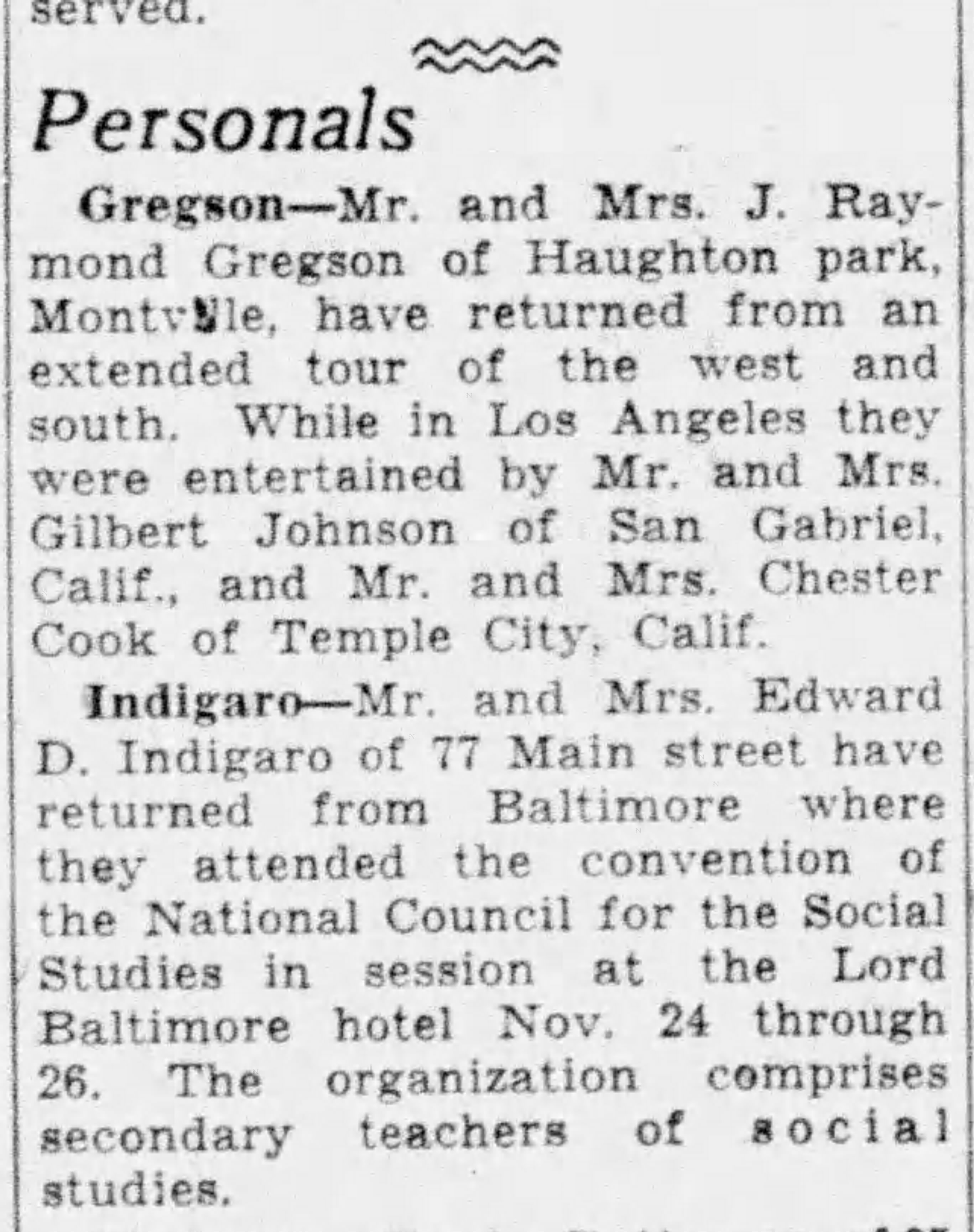
While serving during World War II, Edward married Hazel Viola Luckenbach (née Kaufman) on July 14, 1942, in New London, Connecticut. Edward and Hazel would remain together for more than thirty years. They had no children, although surviving family recollections indicate that Edward maintained close relationships with his extended family. A November 1949 notice in The Day recorded that Mr. and Mrs. Edward D. Indigaro attended the convention of the National Council for the Social Studies at the Lord Baltimore Hotel in Baltimore, November 24 through 26. The notice described the organization as comprising secondary teachers of social studies — raising the possibility that Hazel may have been a social studies teacher, though this has not been independently confirmed.
Hazel's Earlier Marriage and Family
Before her marriage to Edward, Hazel Viola Kaufman was married to Warren Oscar Luckenbach. The couple applied for their marriage license in Lehigh County, Pennsylvania, on July 18, 1914, and were married in Allentown on July 25, 1914.
Their son, Leon Rodney Luckenbach (February 8, 1915 – December 3, 1982), was born in Allentown and later became a college professor at the University of South Florida. Leon married Mary Alyce and had two sons, Baron R. and Rodney R. Luckenbach. At the time of his death, he was also survived by eight grandchildren.
Hazel and Warren also had a daughter, Marion Luckenbach (1917 – August 27, 1949), who later married Gaylen Perin. Additional records indicate Leon had a sister named Laura L. David, suggesting there may have been another daughter in the Luckenbach family whose relationship should be further documented.
Hazel later married Edward Dominic Indigaro on July 14, 1942, in New London, Connecticut. Edward and Hazel had no children together.
World War II — USS Semmes (AG-24)
Edward was already an experienced sailor when the United States entered World War II in December 1941. Rather than joining during the enormous wartime mobilization following Pearl Harbor, he had already accumulated more than twelve years of naval service.
His longtime assignment aboard USS Semmes (AG-24) placed him aboard an unusual Navy vessel. Originally constructed as a destroyer, Semmes was subsequently redesignated as a miscellaneous auxiliary and employed in specialized naval work. As a Boatswain's Mate, Edward belonged to the ship's deck force. His responsibilities would have centered on traditional seamanship, including anchoring, mooring, line handling, rigging, small boats, deck watches, preservation and maintenance, and eventually the supervision of deck crews.
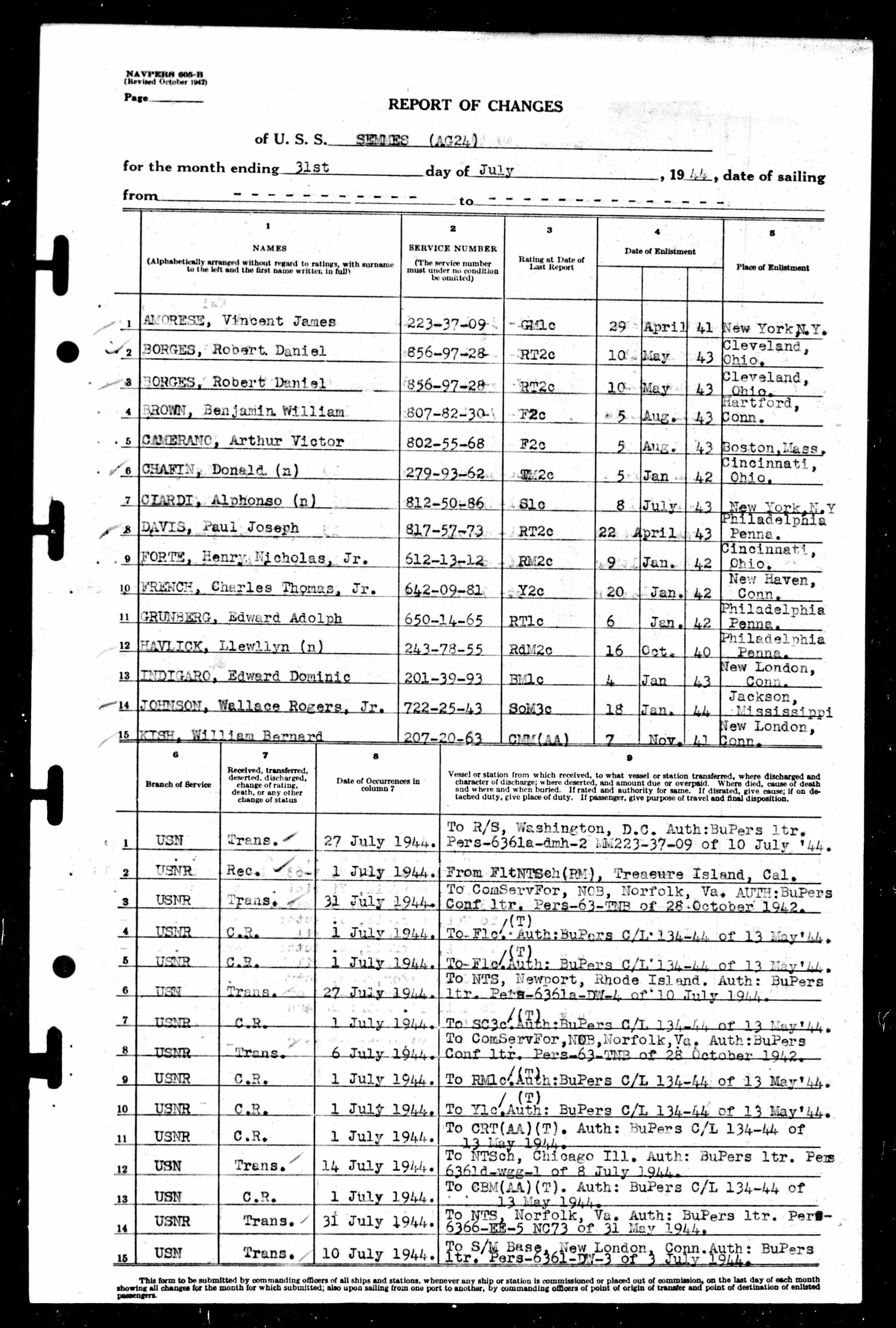
On July 1, 1944, after approximately fifteen years in the Navy, Edward reached one of the defining milestones of his career when he advanced to Chief Boatswain's Mate. His initial chief appointment carried a temporary or acting designation. As a Chief Boatswain's Mate, Edward had entered the Navy's senior enlisted ranks and assumed substantial responsibility for the leadership, training, discipline, and supervision of sailors and deck operations.
Naval Training Station Newport
On August 2, 1944, Edward was received at Newport, Rhode Island, beginning what became one of the longest and best-documented shore assignments of his career. Subsequent records repeatedly document Edward at the naval training establishment throughout the remainder of World War II and into the postwar years.
On September 1, 1945, Edward's status changed from CBM (AA)(T) to CBM, removing the temporary or acting designation associated with his earlier advancement to Chief Boatswain's Mate. Edward remained at Newport after the end of World War II, with records continuing to place him there through 1946 and into 1947.
On January 2, 1947, Edward reenlisted for another four years. By this point, he had accumulated nearly eighteen years of naval service. Taken together, the surviving records establish Edward's Newport assignment from August 2, 1944 into the spring of 1947 — a period approaching three years.
Temporary Assignment — USS Utina (ATF-163)
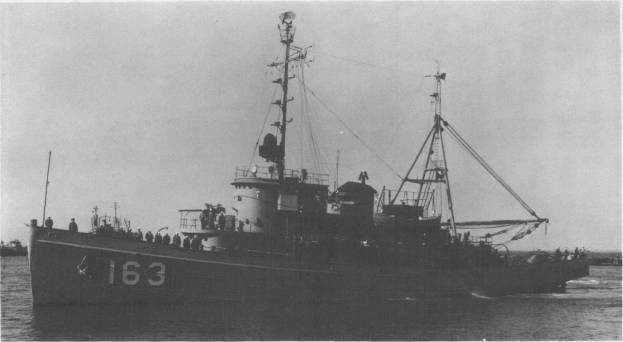
The closing weeks of Edward's Newport period brought a particularly interesting personnel movement. A May 29, 1947 Fleet Training Center Newport muster records a personnel action dated May 23, 1947, involving a temporary transfer from Receiving Station Norfolk to USS Utina (ATF-163) at Guantánamo Bay, Cuba.
Utina was a fleet ocean tug operating from Guantánamo Bay during this period. As an experienced Chief Boatswain's Mate, Edward's background in seamanship, rigging, heavy line handling, deck operations, and supervision would have been directly applicable to the work performed aboard a fleet tug. The surviving entry does not establish exactly how long Edward remained aboard the tug or identify a specific operation in which he participated.
USS Borie (DD-704)
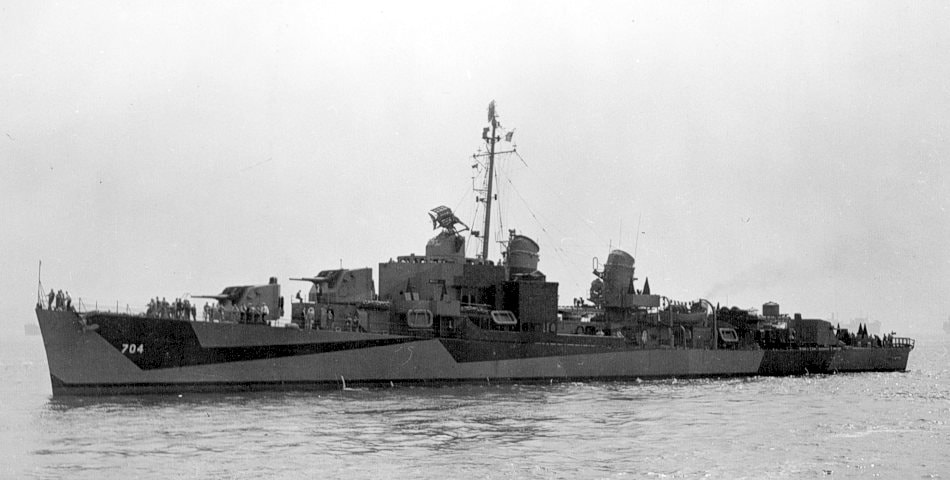
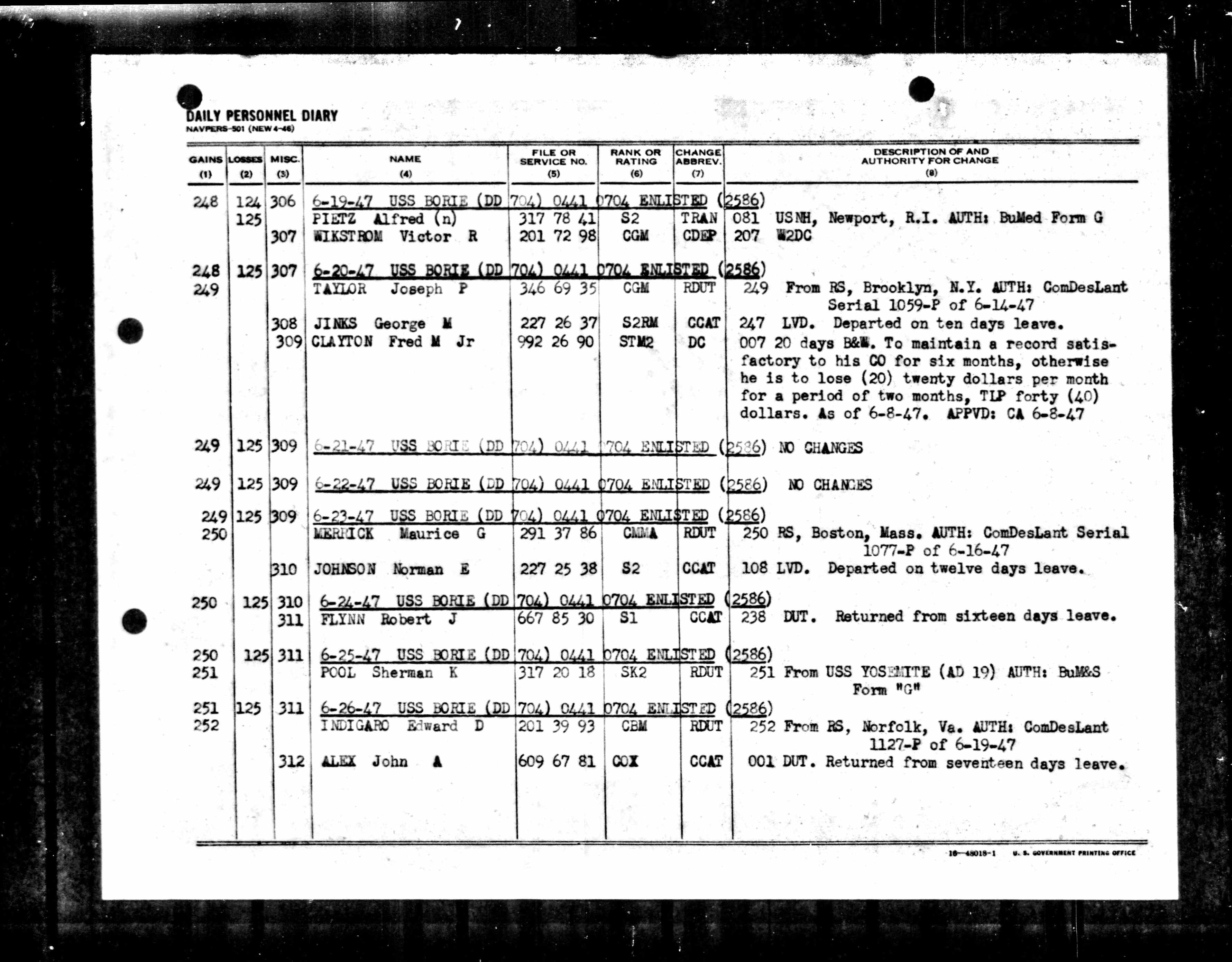
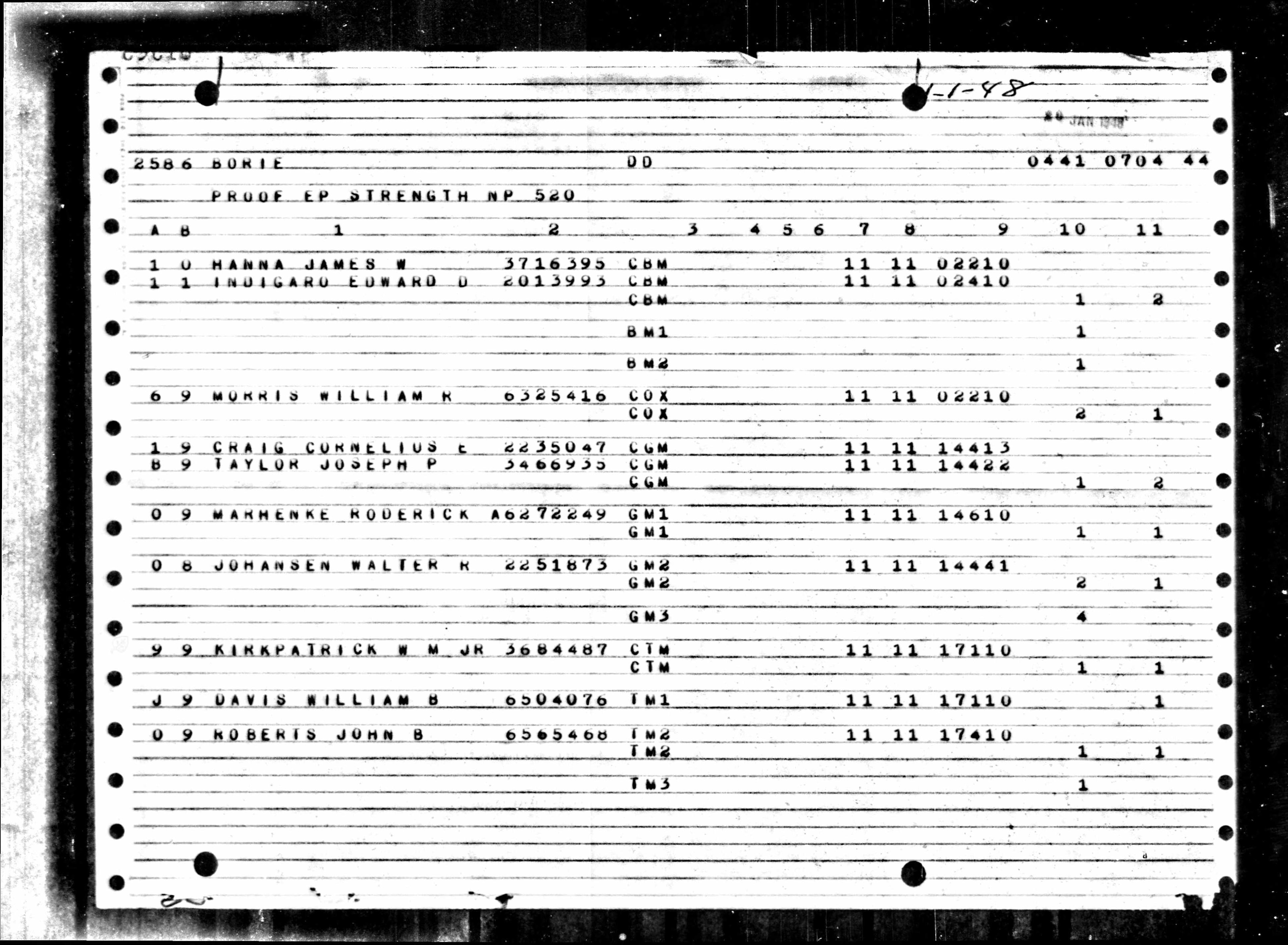
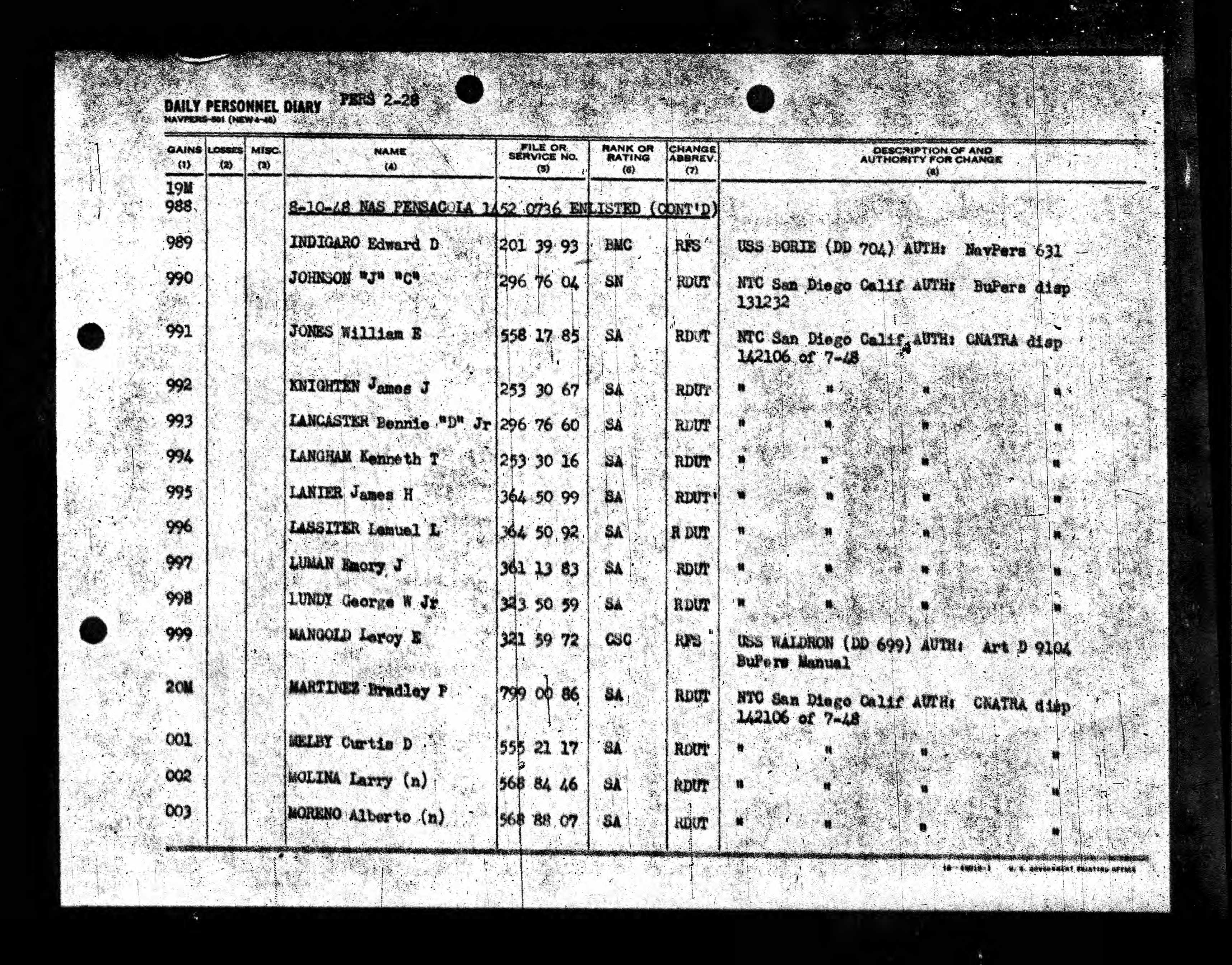
By late June 1947, Edward was returning to regular shipboard duty. On June 26, 1947, Edward was transferred from the Norfolk area to USS Borie (DD-704) under the authority of Commander, Destroyers, Atlantic Fleet. A Proof of Strength muster dated July 25, 1947, carries Edward on Borie's rolls, firmly establishing his presence aboard the destroyer. He remained associated with the ship into 1948.
One family recollection provides a rare personal glimpse of Edward as an experienced sailor during the later portion of his career. Edward reportedly recalled working alongside another older, experienced sailor during work associated with the decommissioning of a ship. Some younger sailors jokingly referred to the pair as the "old guys" and apparently doubted whether they could accomplish a particular task. According to Edward's story, he and the other veteran sailor proceeded to complete the task with ease, drawing upon the practical knowledge and seamanship they had accumulated during decades in the Navy.
Fleet Reserve and Civilian Life in New London
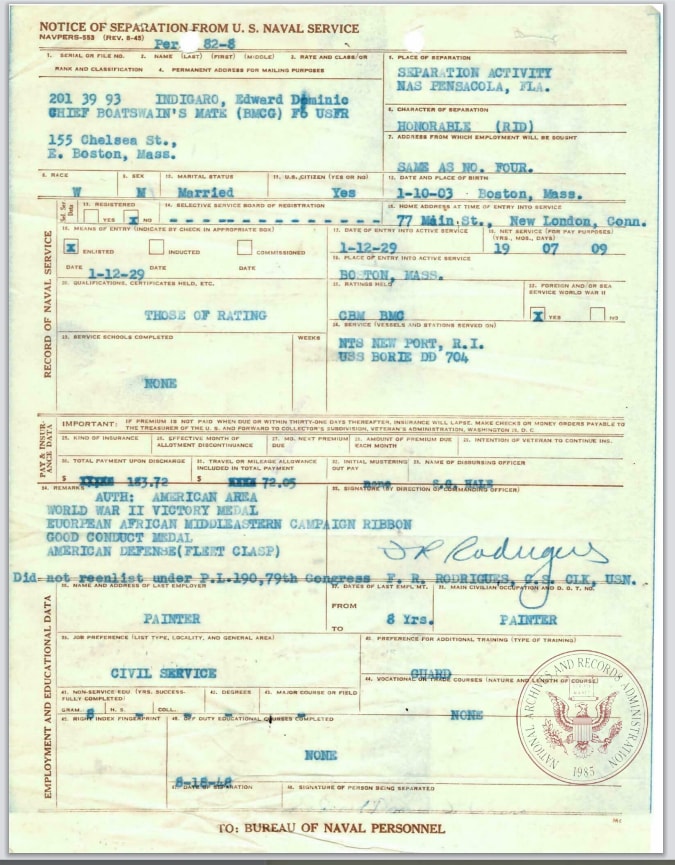
On August 18, 1948, Edward was officially transferred to the Fleet Reserve, bringing his first lengthy period of continuous active service to a close after more than nineteen years. Edward and Hazel continued to make their home at 77 Main Street in New London, Connecticut.
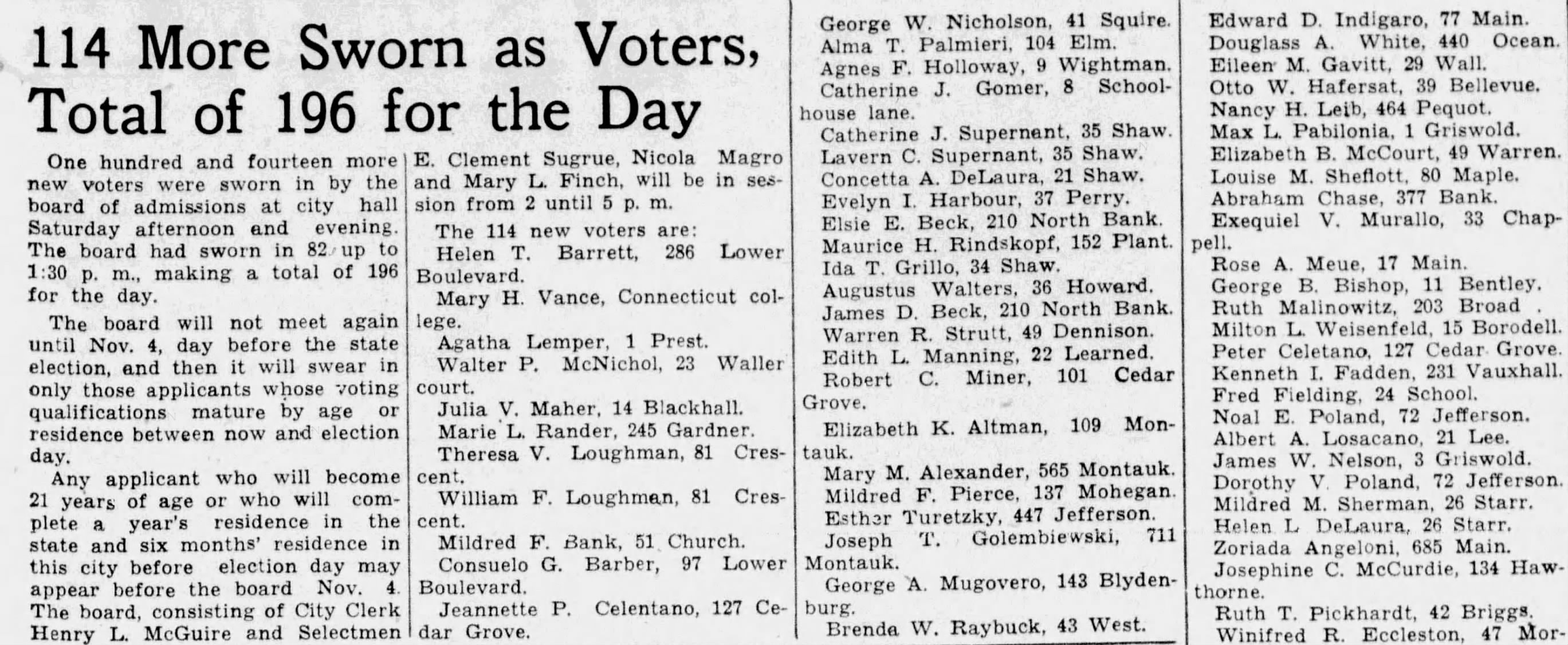
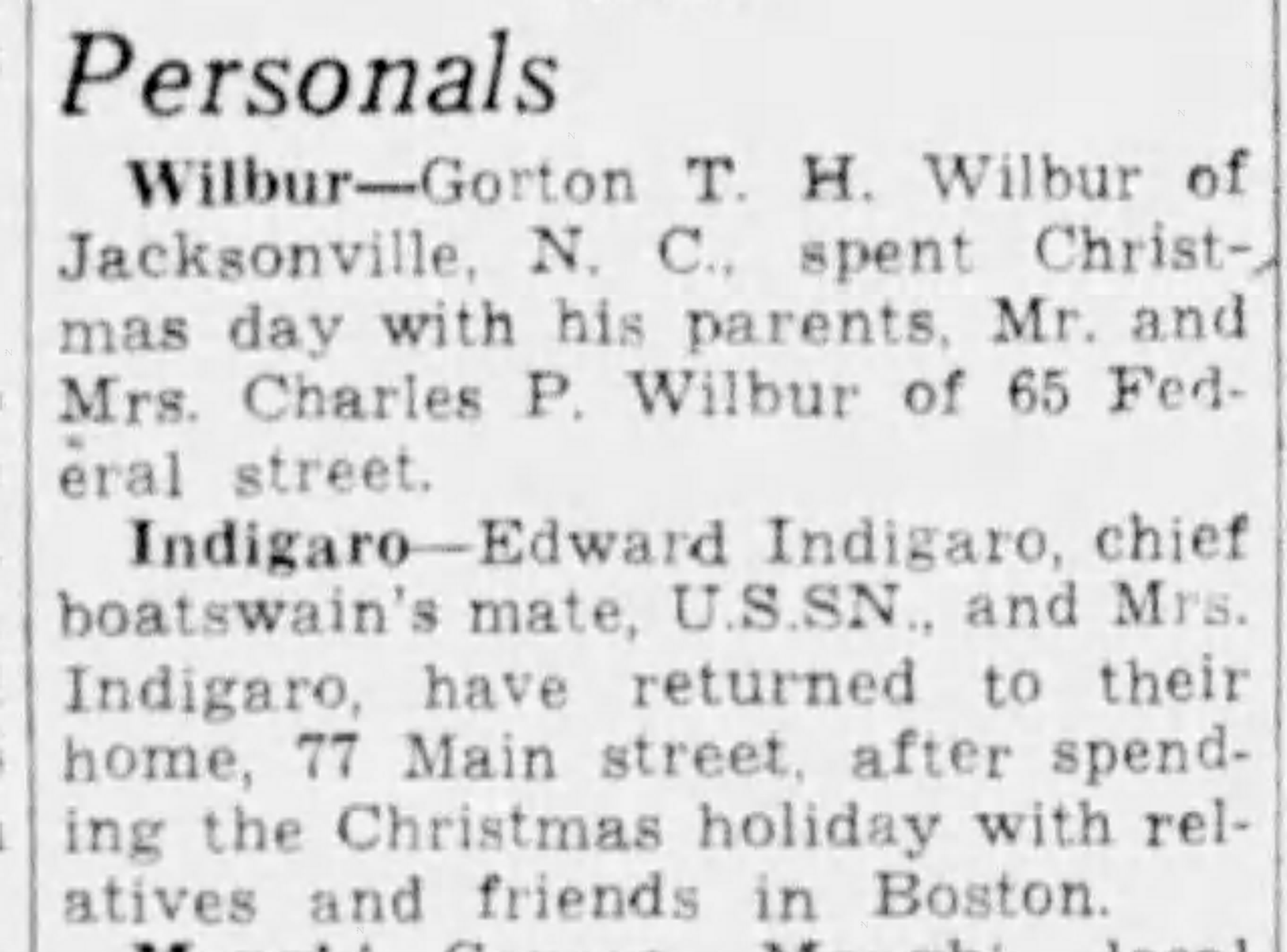
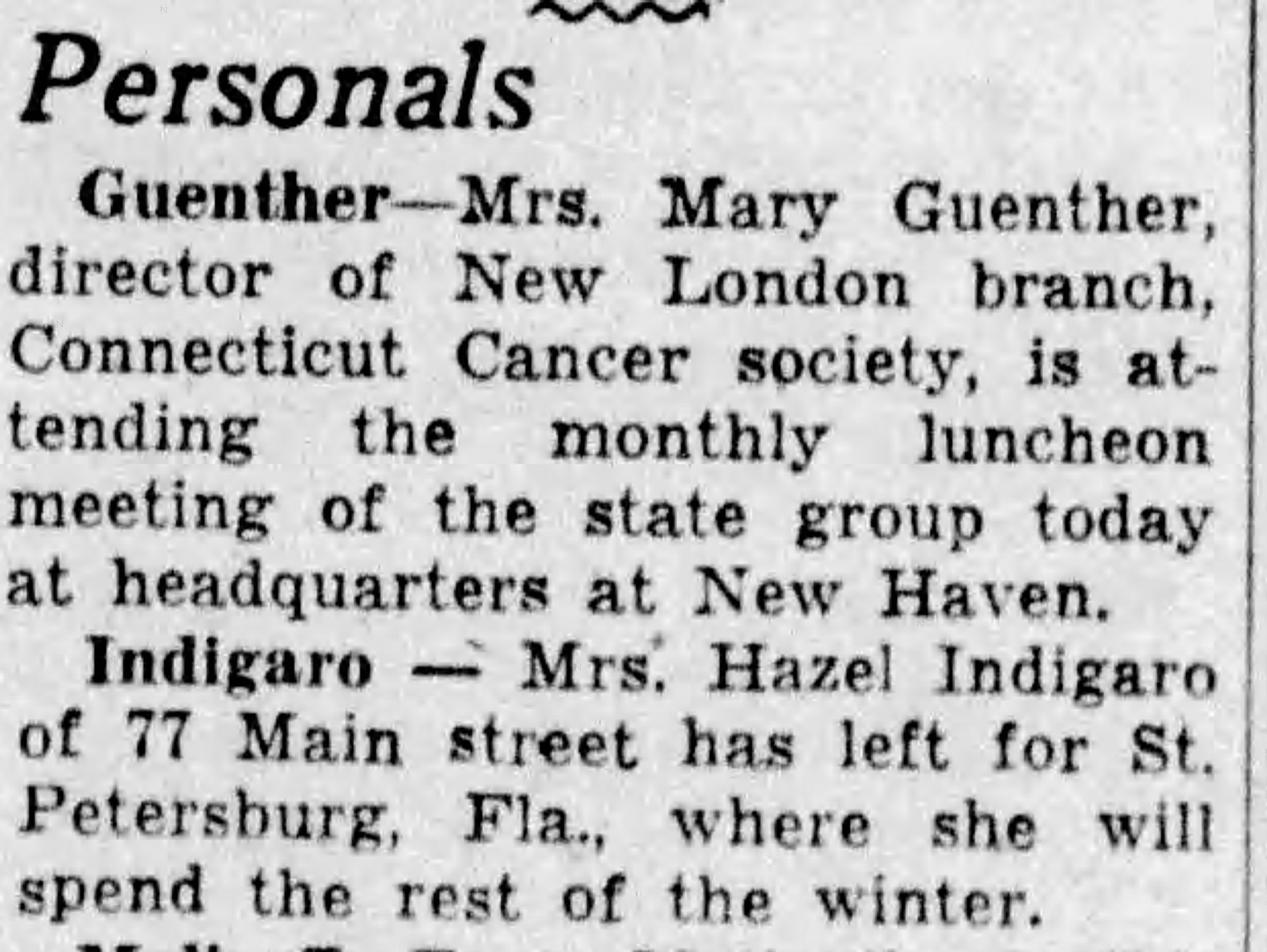
Contemporary newspaper notices provide several unusually personal glimpses into their lives during this brief civilian interlude. In January 1949, Hazel left New London for St. Petersburg, Florida, where she intended to spend the remainder of the winter. A voter registration record from New London listing "Edward D. Indigaro, 77 Main" among newly sworn voters at City Hall further confirms his continued residence at that address during this period. A separate Christmas notice recorded that Edward, identified as chief boatswain's mate, U.S.S.N., and Mrs. Indigaro had returned to their home at 77 Main Street after spending the Christmas holiday with relatives and friends in Boston.
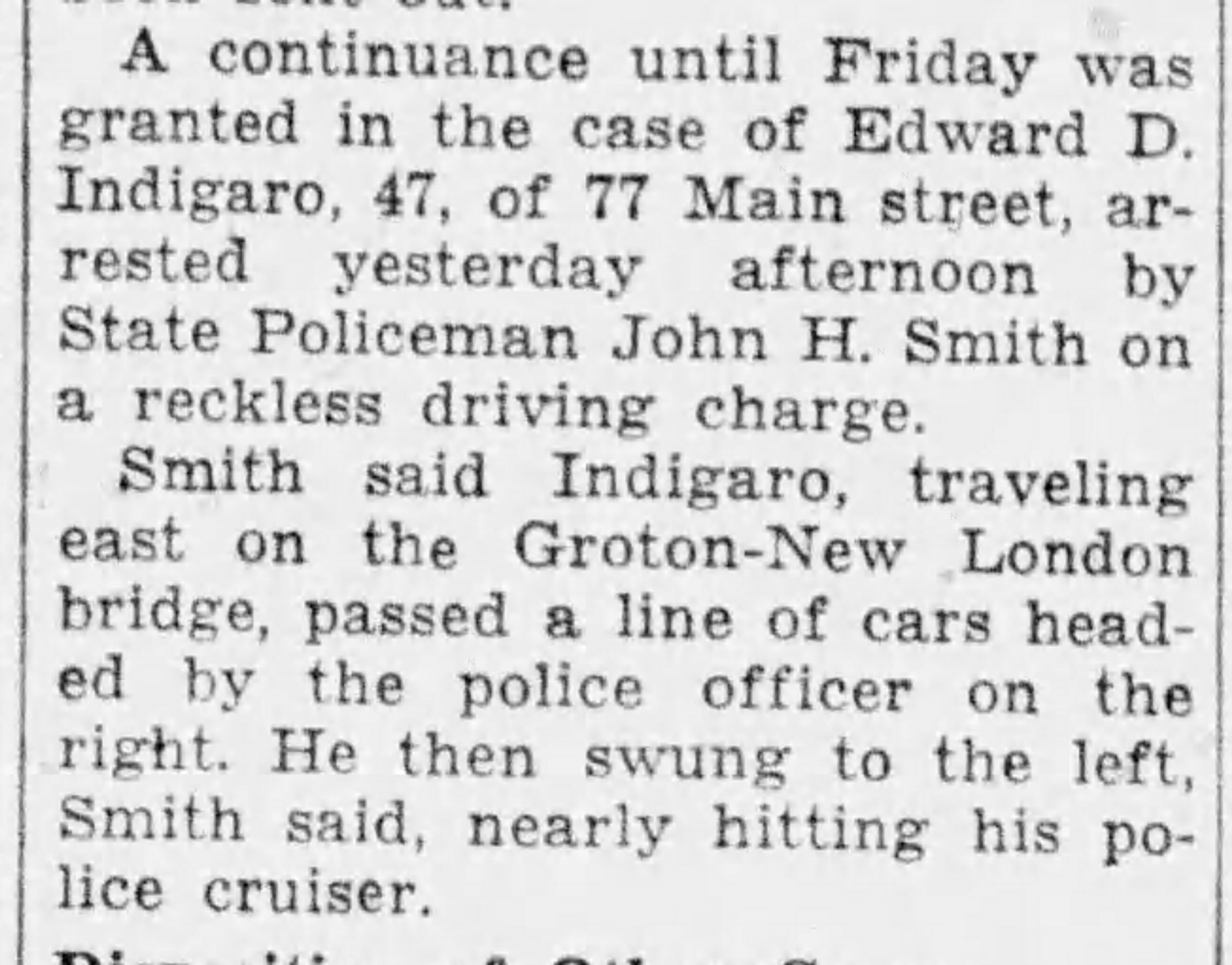
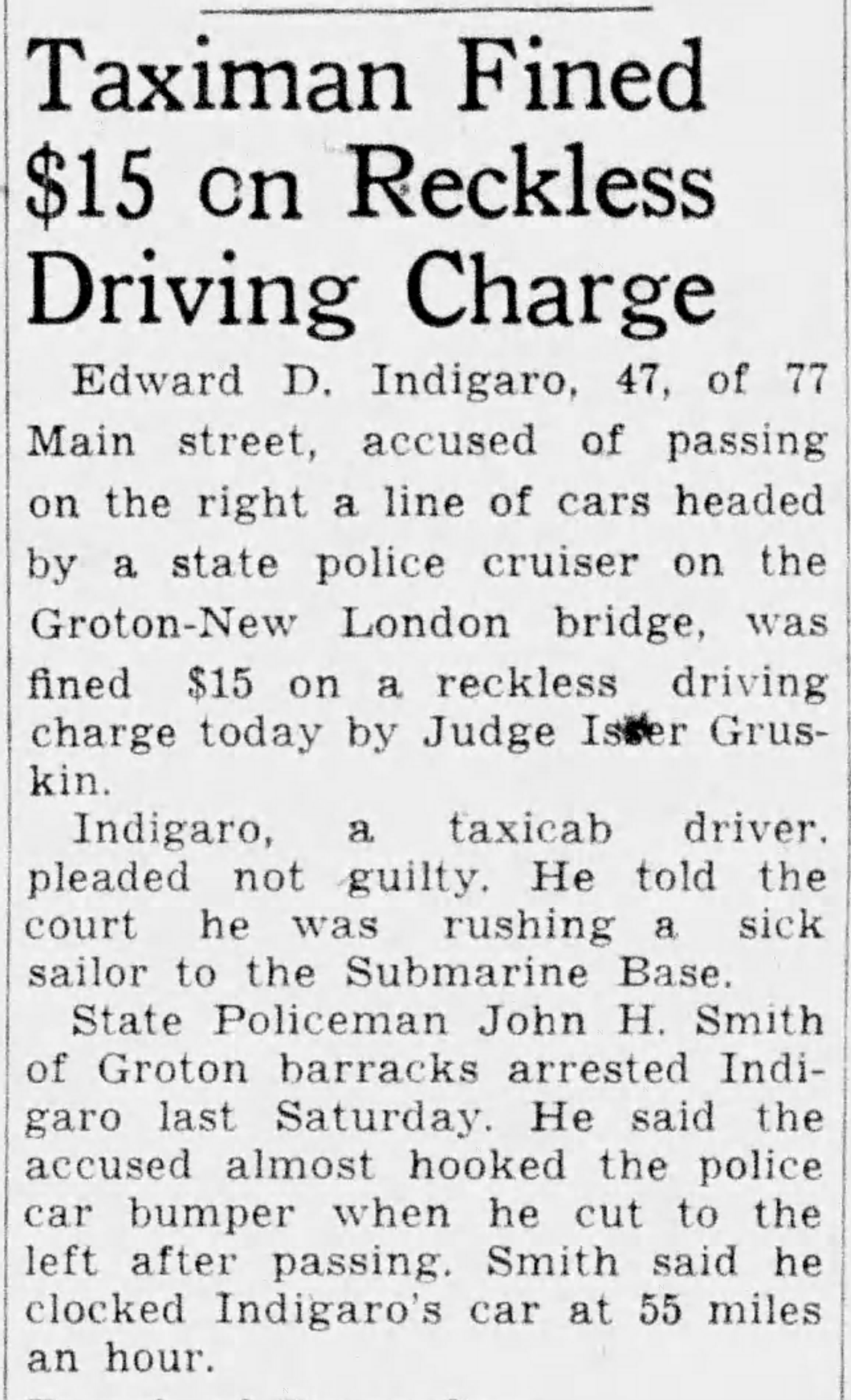
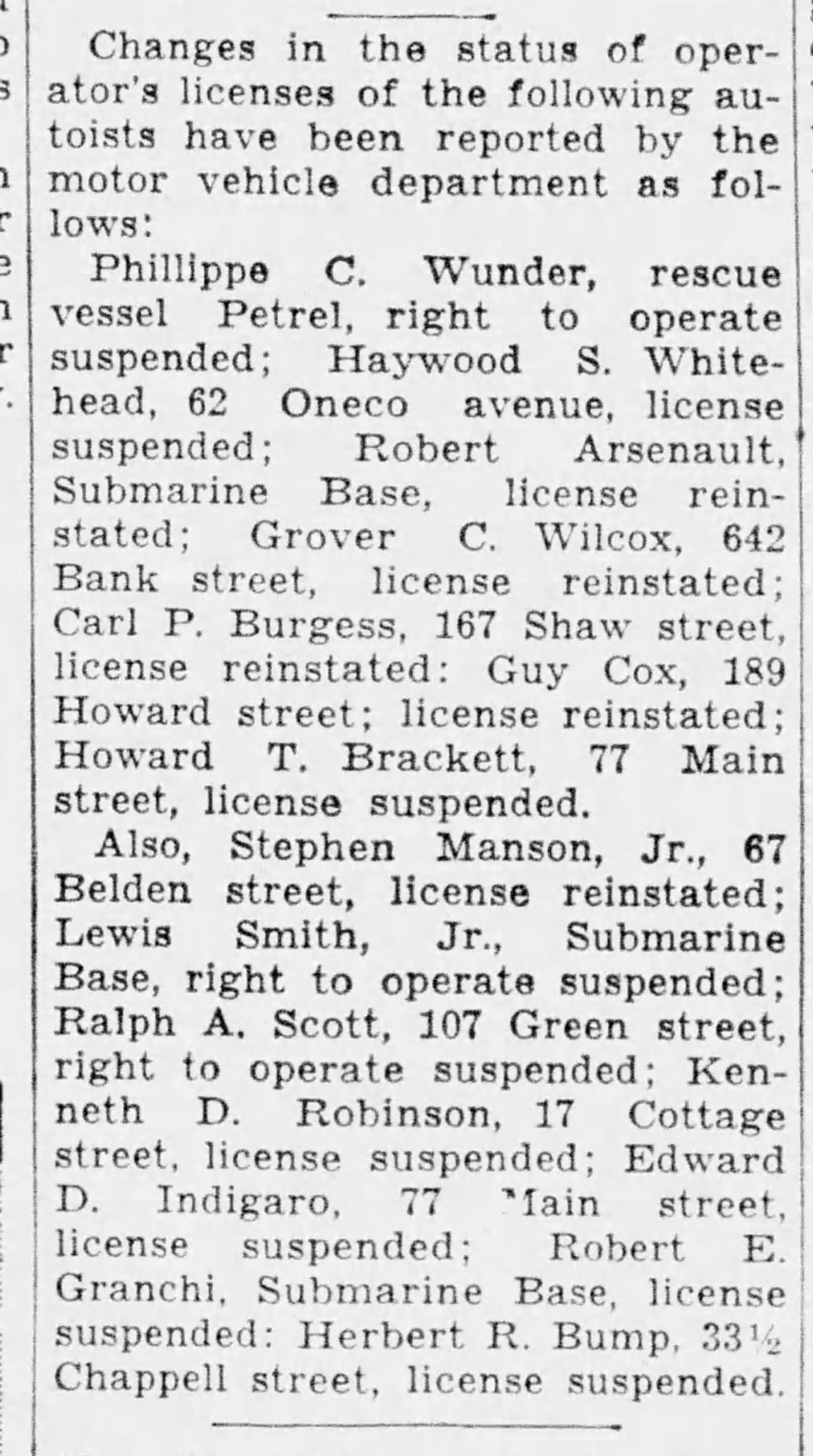
By August 1950, Edward was working as a taxicab driver. A newspaper account from that month records an unusual episode: Edward was arrested on a reckless-driving charge after passing a line of vehicles on the Groton–New London Bridge. He pleaded not guilty and explained to the court that he had been rushing a sick sailor to the Submarine Base. Edward was ultimately fined $15, and his driver's license was suspended. Even while earning his living as a civilian taxicab driver, the longtime Chief remained closely connected with the naval community surrounding New London and Groton.
Recall to Active Duty — Korean War Era
With the Korean War underway, Edward was recalled from the Fleet Reserve to active naval service. A surviving Navy muster from Receiving Station Brooklyn, New York, records Edward's personnel action as "Recall Active Duty." Edward was now in his late forties and returned to the Navy as an experienced Chief Boatswain's Mate with more than two decades of naval experience.
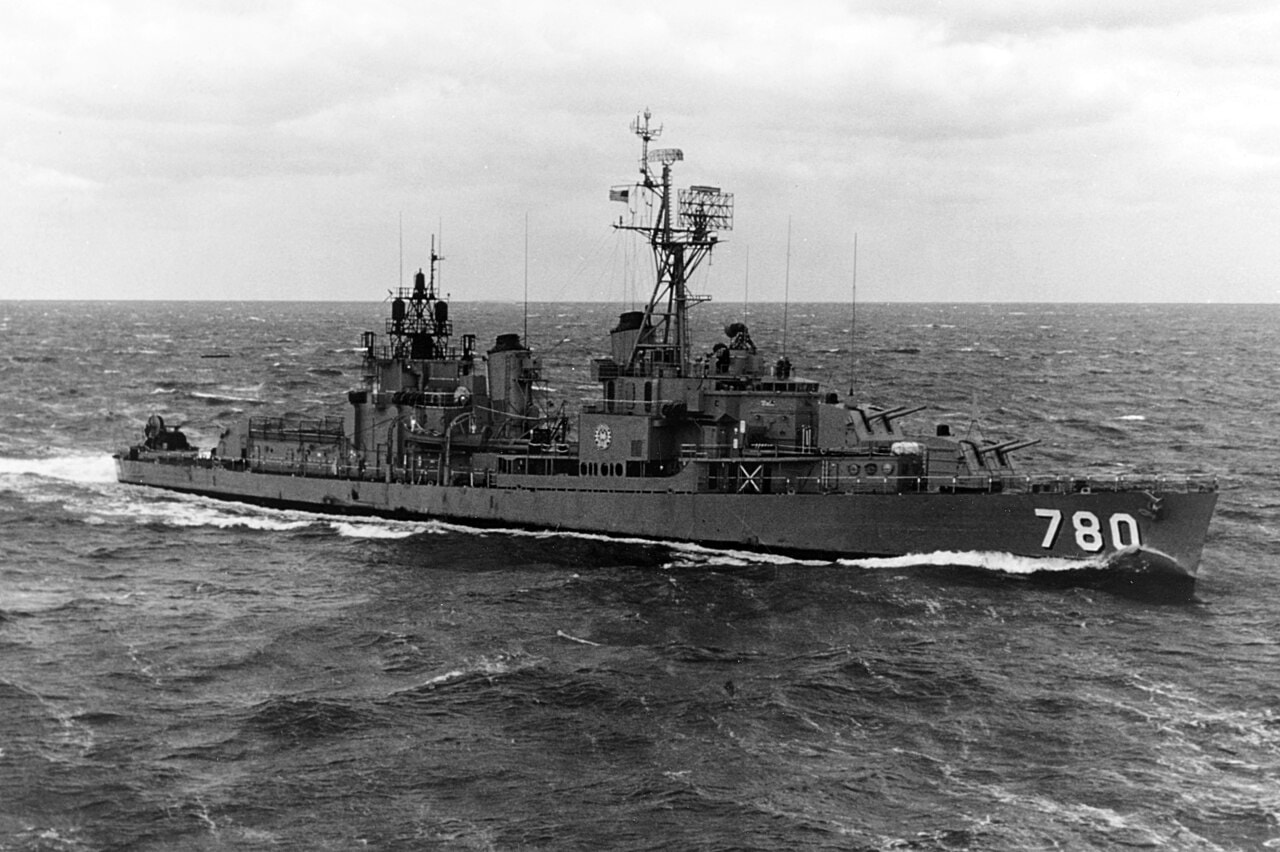
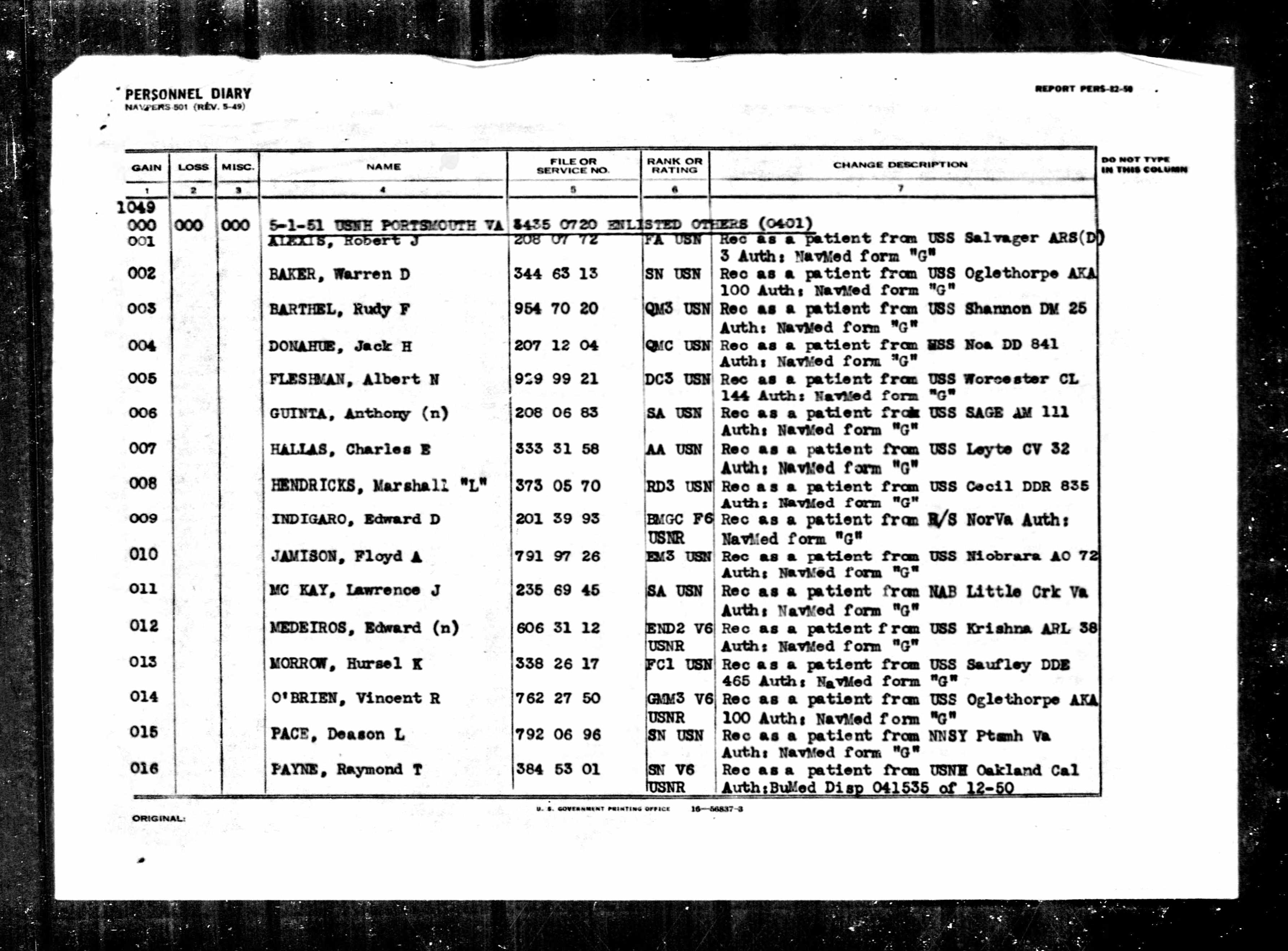
In April 1951, Edward's records document transfer orders involving USS Stormes (DD-780). The following month brought a complicated series of personnel movements involving Recruit Training Command Newport, Receiving Station Norfolk, and Naval Hospital Portsmouth, Virginia. The surviving records establish a period of medical processing or hospitalization at Naval Hospital Portsmouth. The reason for his treatment has not yet been identified.
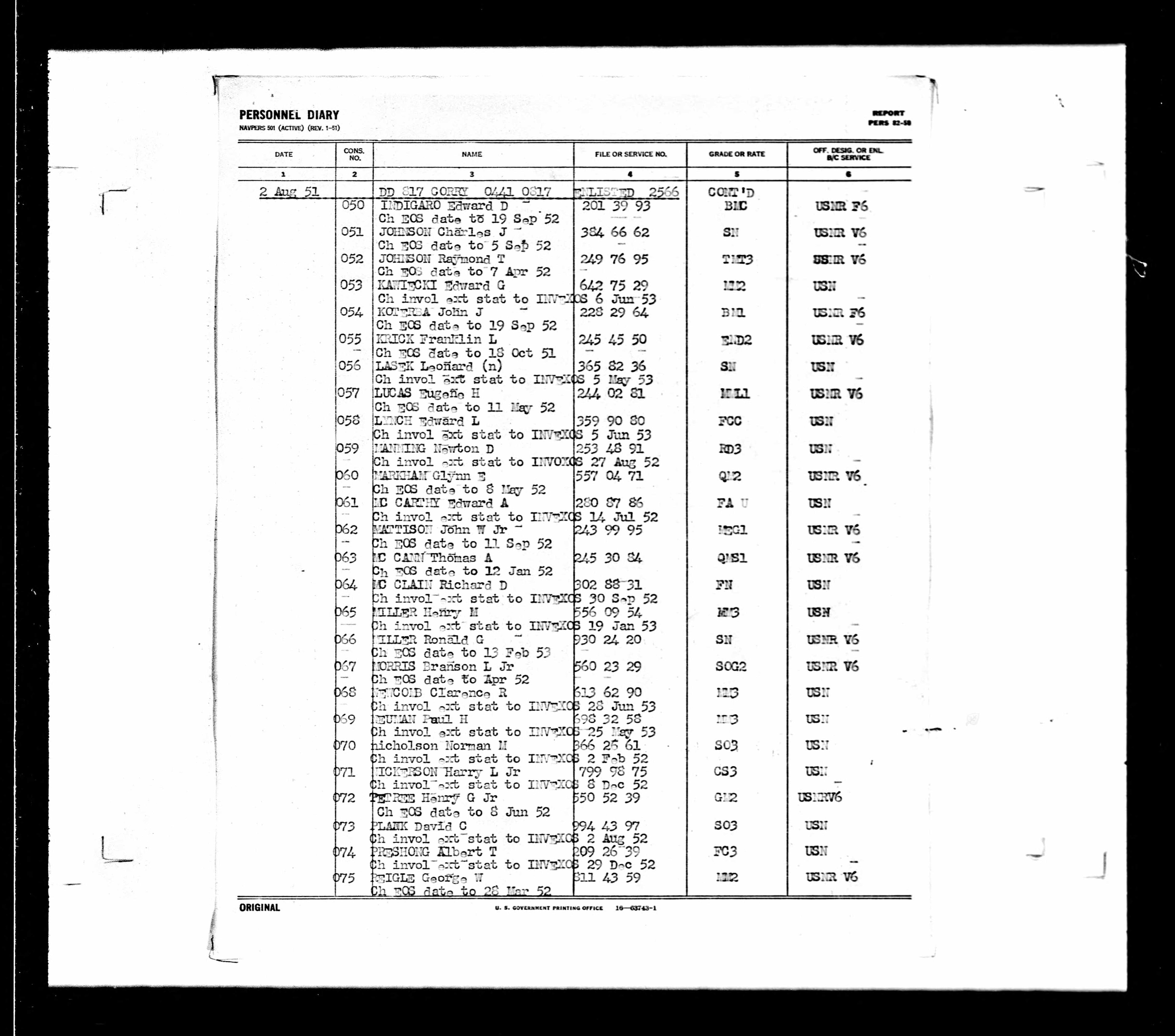
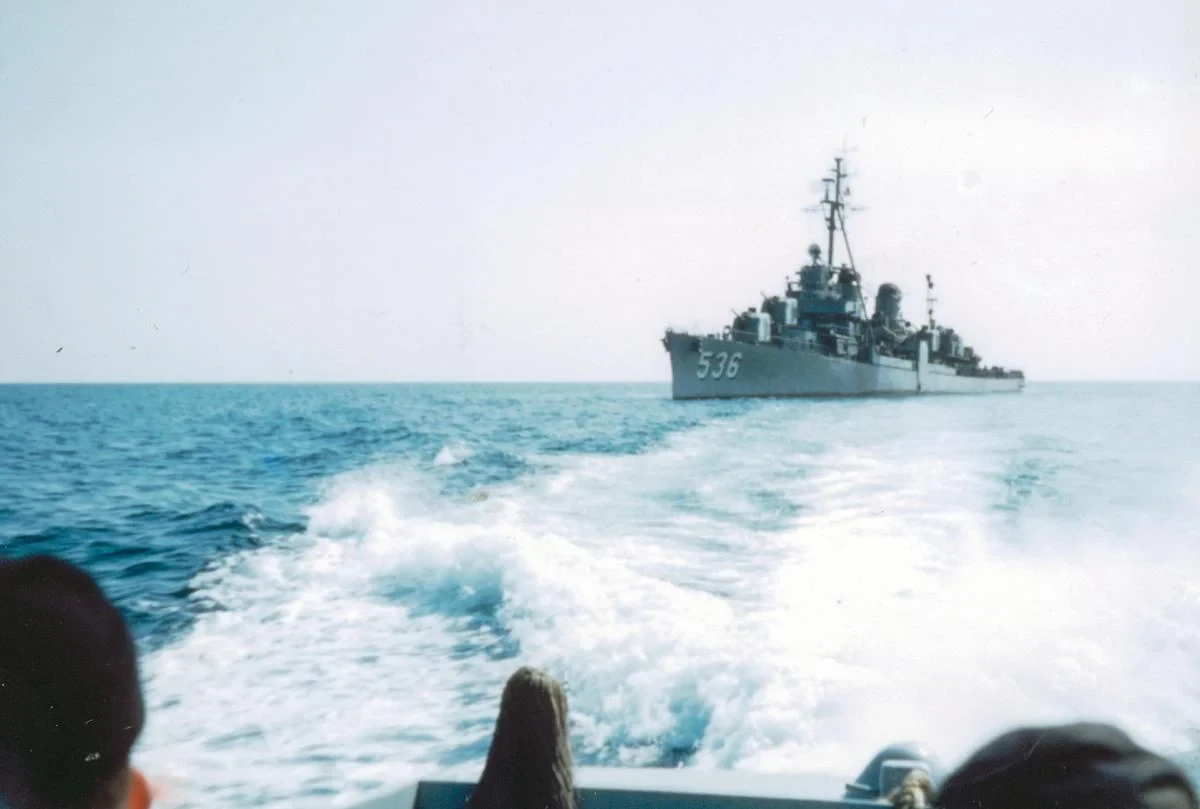
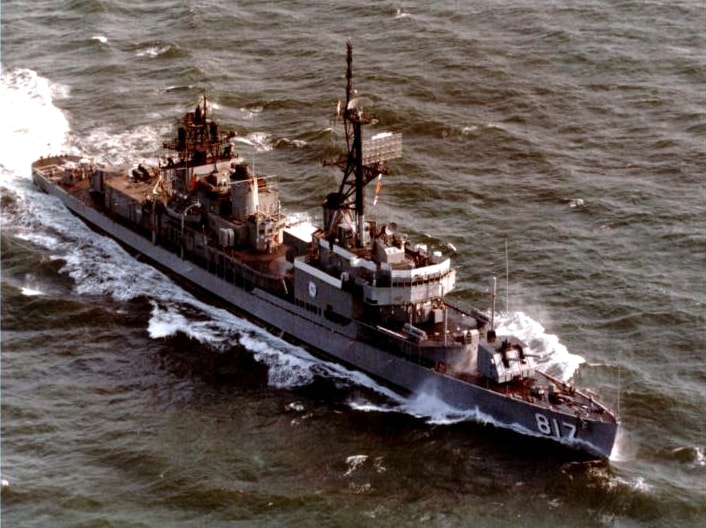
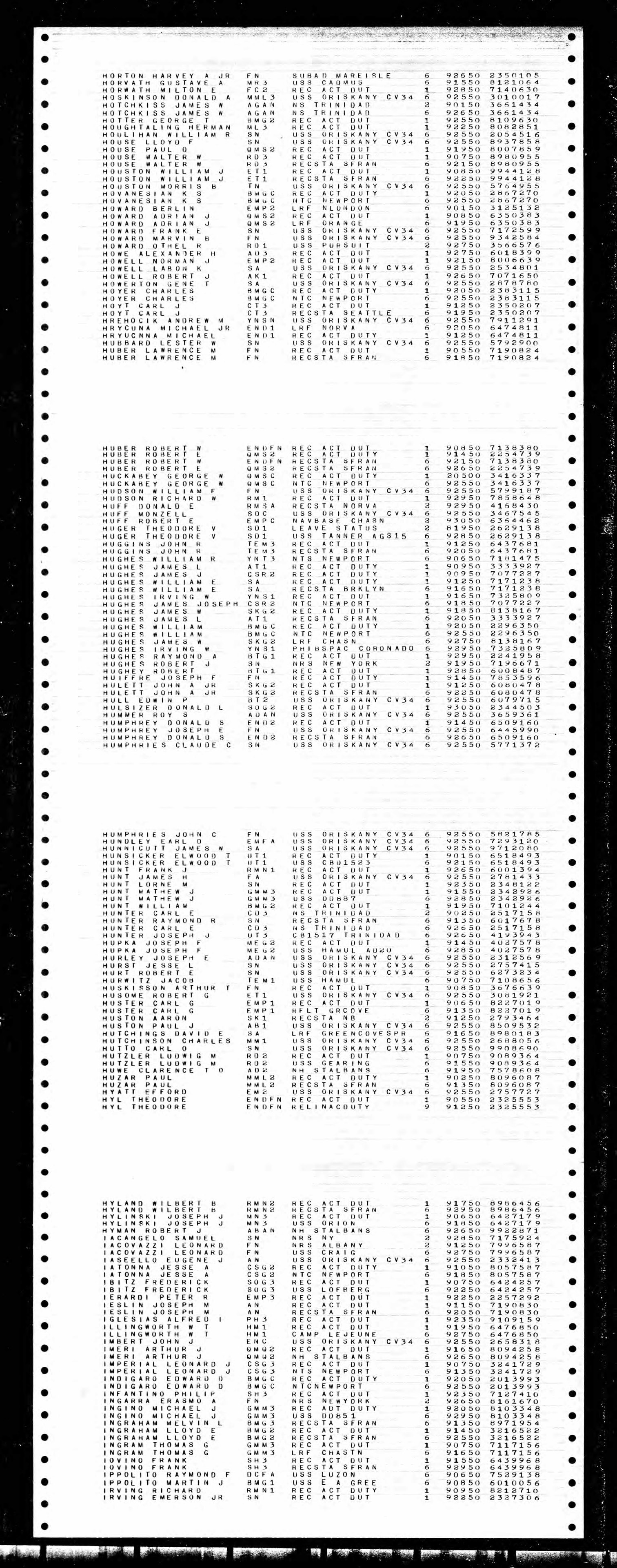
By August 1951, Edward appears directly on a USS Corry (DD-817) muster roll, confirming his association with the destroyer. Records continue to connect Edward with Corry into 1952. Edward subsequently became associated with USS Owen (DD-536), with records from 1952 documenting his service and eventual movement toward inactive-duty status. Owen subsequently deployed to the Far East, but the records currently discovered indicate that Edward was moving toward inactive-duty status before that deployment.
Decorations and Recognition
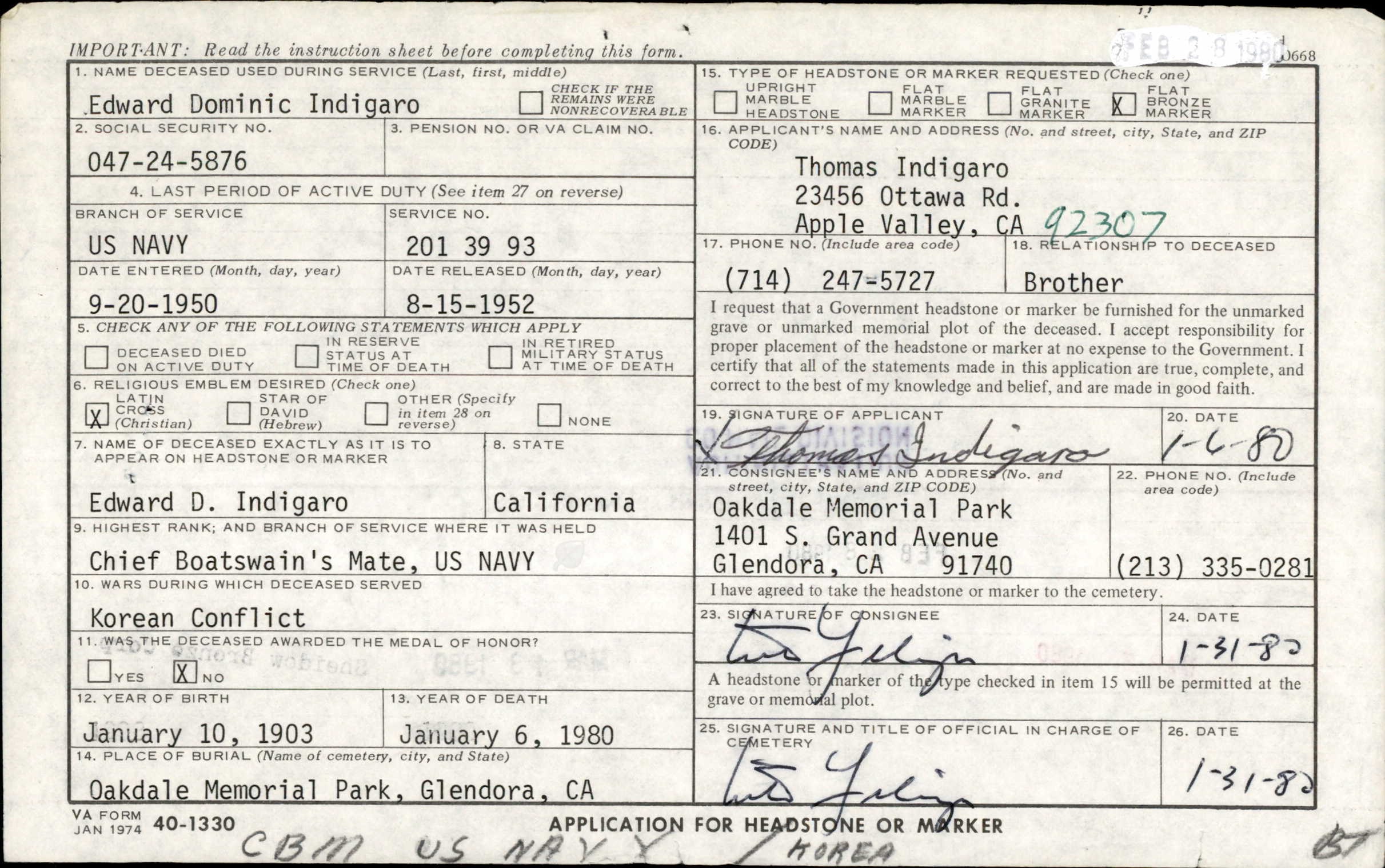
Edward's surviving naval documentation identifies several decorations associated with his lengthy service: the American Defense Service Medal with Fleet Clasp, the American Campaign Medal, the European-African-Middle Eastern Campaign Medal, the World War II Victory Medal, and the Good Conduct Medal. His grave recognizes his service during both World War II and the Korean War, consistent with his documented recall to active duty during the latter conflict.
Retirement from the United States Navy
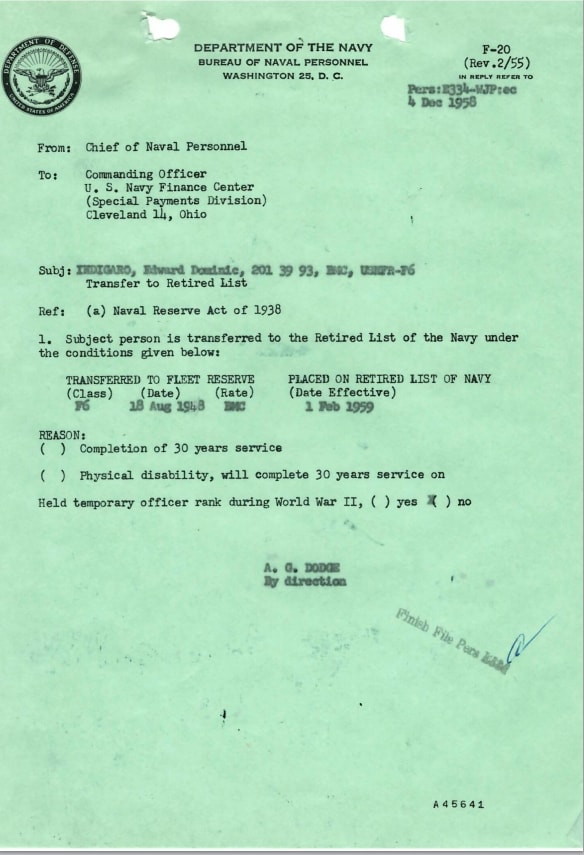
On December 4, 1958, the Bureau of Naval Personnel issued orders directing that Chief Boatswain's Mate Edward Dominic Indigaro be placed on the Retired List of the United States Navy effective February 1, 1959. Approximately thirty years had passed since Edward first enlisted in Boston.
Life in Southern California
Following his final period of active naval service, Edward and Hazel eventually made their way west. A separate 1956 voter registration record — distinct from the New London registration — places Edward in Los Angeles County, California, providing the earliest evidence discovered thus far of his residence in Southern California. By 1960, records place Edward in Alhambra, California. His formal placement on the Navy's Retired List in 1959 therefore occurred during the early years of his life in Southern California.
Remembered by Family
The official records document Edward's ships, ratings, transfers, and promotions. Family memories preserve something equally important: the man himself.
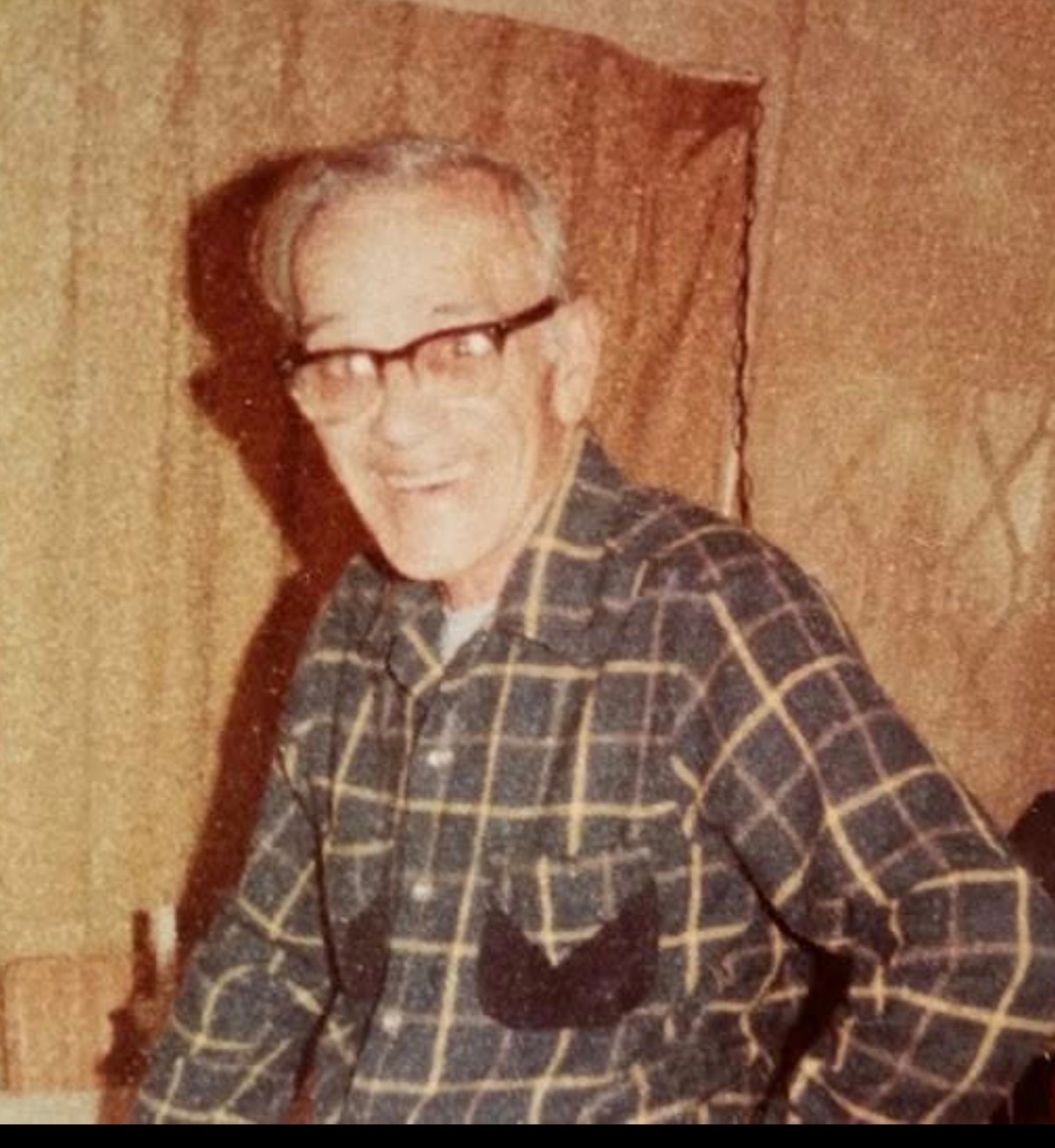
Evelyn Ann Indigaro, granddaughter of Edward's brother Thomas Indigaro, remembered her great-uncle as deeply family-oriented, kind, generous, humorous, and also stern. She remembered Edward physically as short and stocky and nearly bald later in life. Edward apparently also possessed considerable charm — Evelyn remembered him as being "a little bit of a ladies' man."
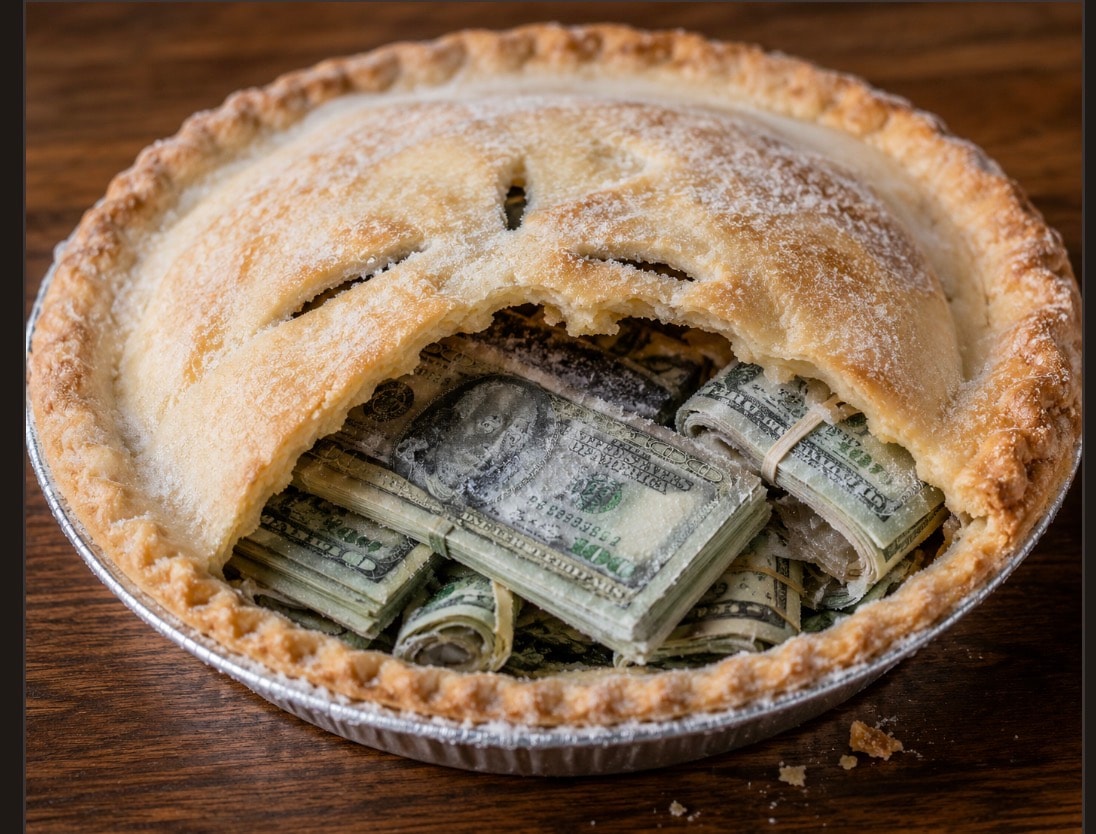
During his years in Southern California, Edward enjoyed going to Santa Anita Park, the famed racetrack in Arcadia. Evelyn also remembered one of Edward's more unusual habits: he would hide or freeze some of his savings inside pies. These small details provide an invaluable window into Edward's personality. The career Chief Boatswain's Mate revealed by Navy records could be stern, disciplined, and experienced. The Edward remembered by his family was also generous, funny, devoted to those close to him, somewhat mischievous, and full of personality.
The Loss of Hazel
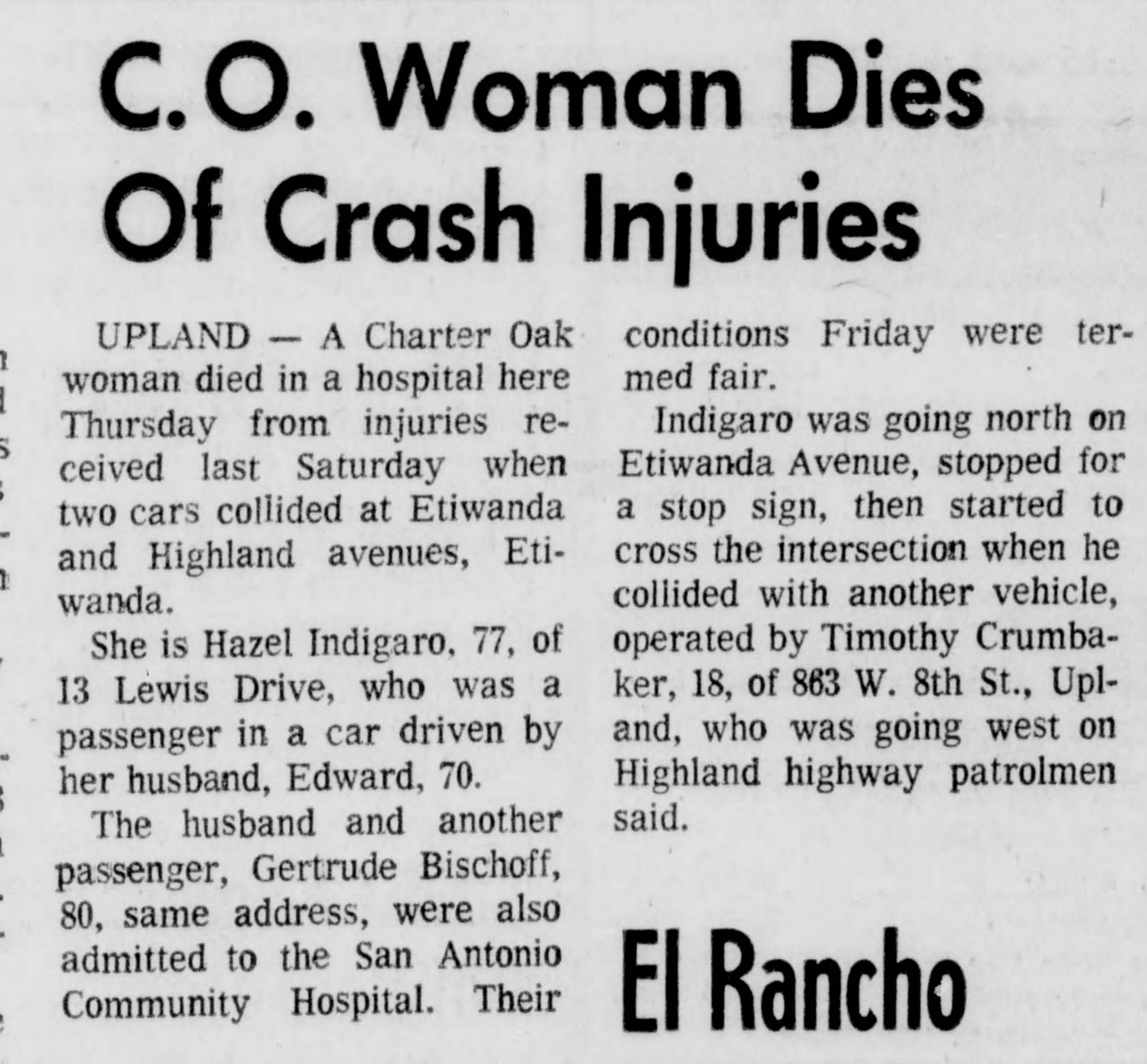
Edward and Hazel had been married for more than thirty years when tragedy struck in 1973. In early 1973, Edward and Hazel were involved in a serious automobile collision at the intersection of Etiwanda and Highland avenues in Southern California. Edward, then seventy, was driving, with Hazel and another passenger in the vehicle.
According to a contemporary newspaper account, Edward had been traveling north on Etiwanda Avenue and stopped at a stop sign before beginning to cross the intersection. His vehicle then collided with another automobile traveling west on Highland. Edward, Hazel, and their passenger were admitted to San Antonio Community Hospital. Hazel suffered severe injuries in the collision.
Hazel Viola Indigaro died on February 3, 1973, at the age of seventy-seven, from injuries sustained in the accident. Her death ended a marriage of more than thirty years, beginning with their wedding in New London on July 14, 1942. Edward survived his wife by nearly seven years.
Final Years and Death
Edward remained in Southern California following Hazel's death. He eventually resided in Covina, California, spending his final years far from the Boston neighborhood where his life had begun and the East Coast naval communities where he had spent much of his career.
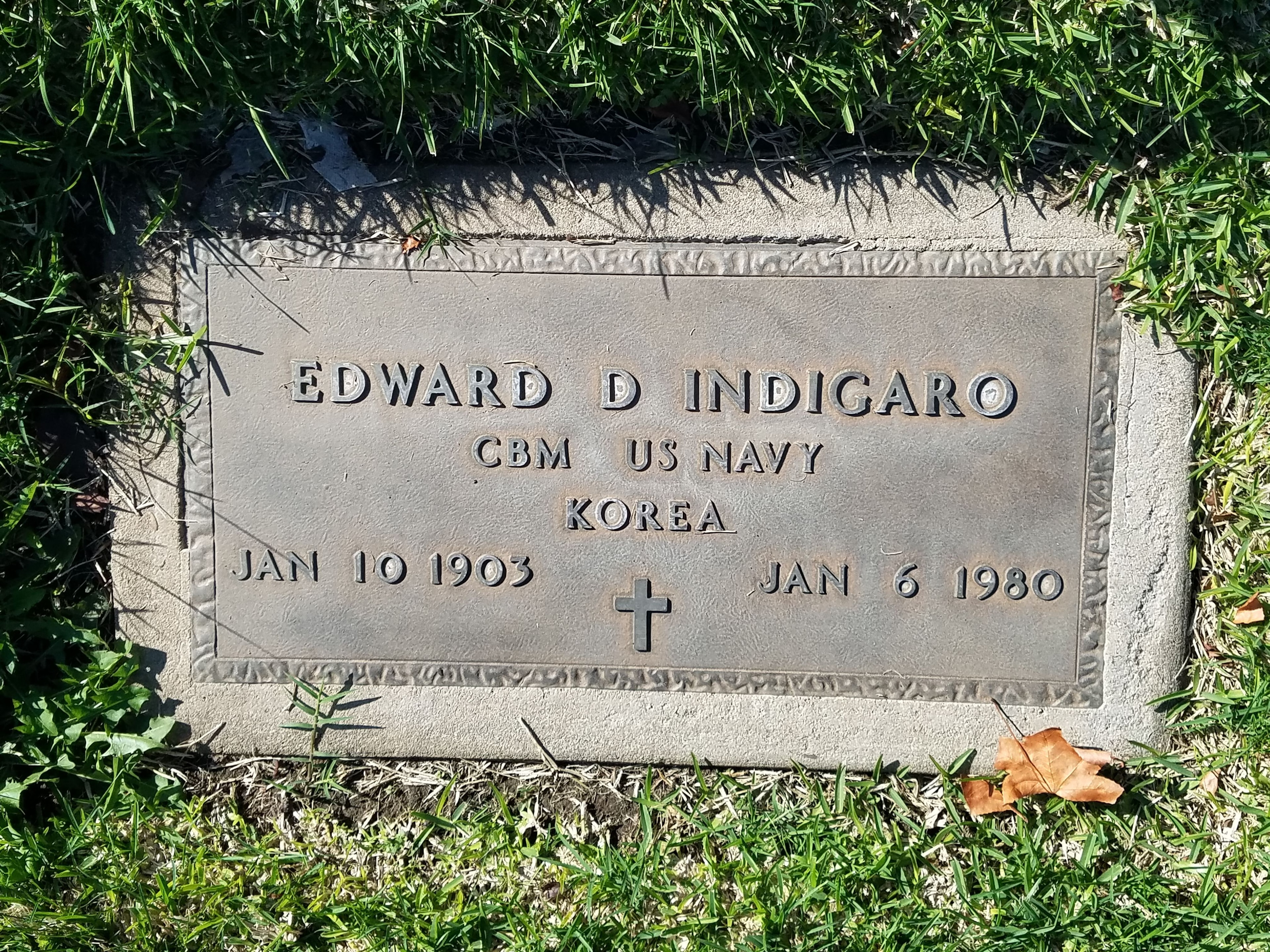
Edward Dominic Indigaro died on January 6, 1980, just four days before his seventy-seventh birthday. He was laid to rest at Oakdale Memorial Park in Glendora, California. His death came more than half a century after he first entered the United States Navy and more than twenty years after his formal placement on the Navy's Retired List.
Primary Sources
The Taxi Incident — New London, 1950
Three contemporary newspaper accounts document the full arc of the incident: the arrest and continuance, the verdict and fine, and the subsequent license suspension. Together they provide a remarkably complete record of a single episode in Edward's civilian life between periods of naval service.
Primary Sources
Hazel at 77 Main Street — New London, 1940s–1950s
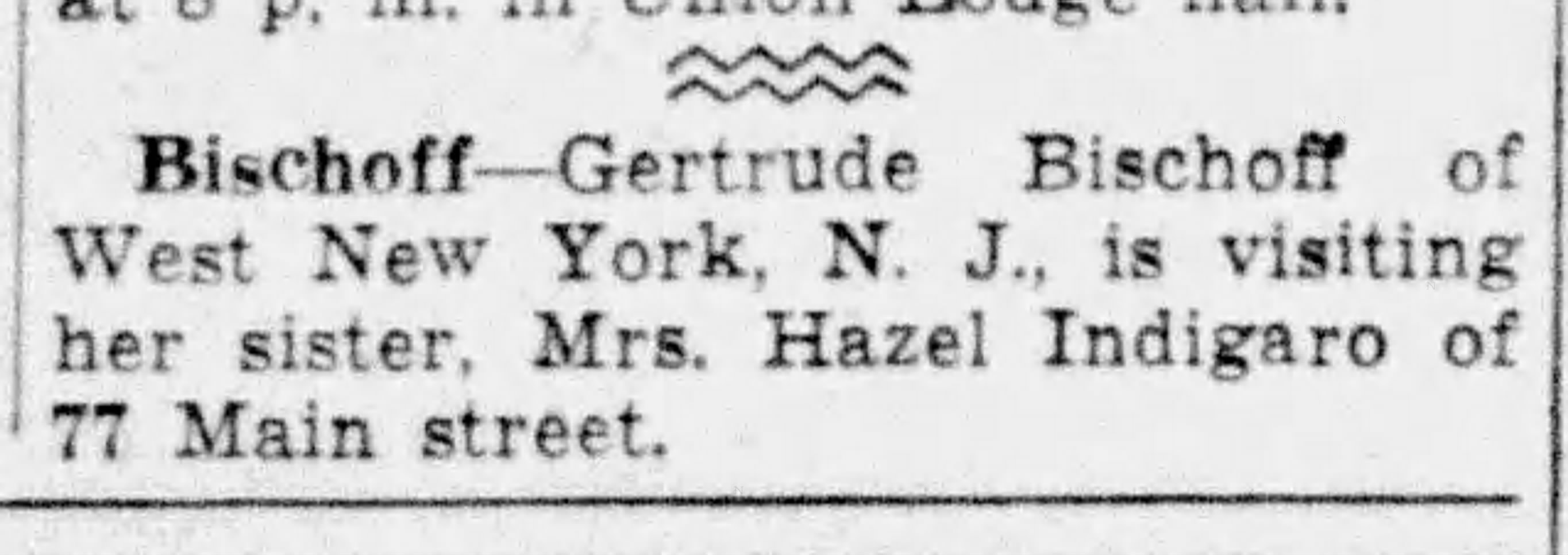
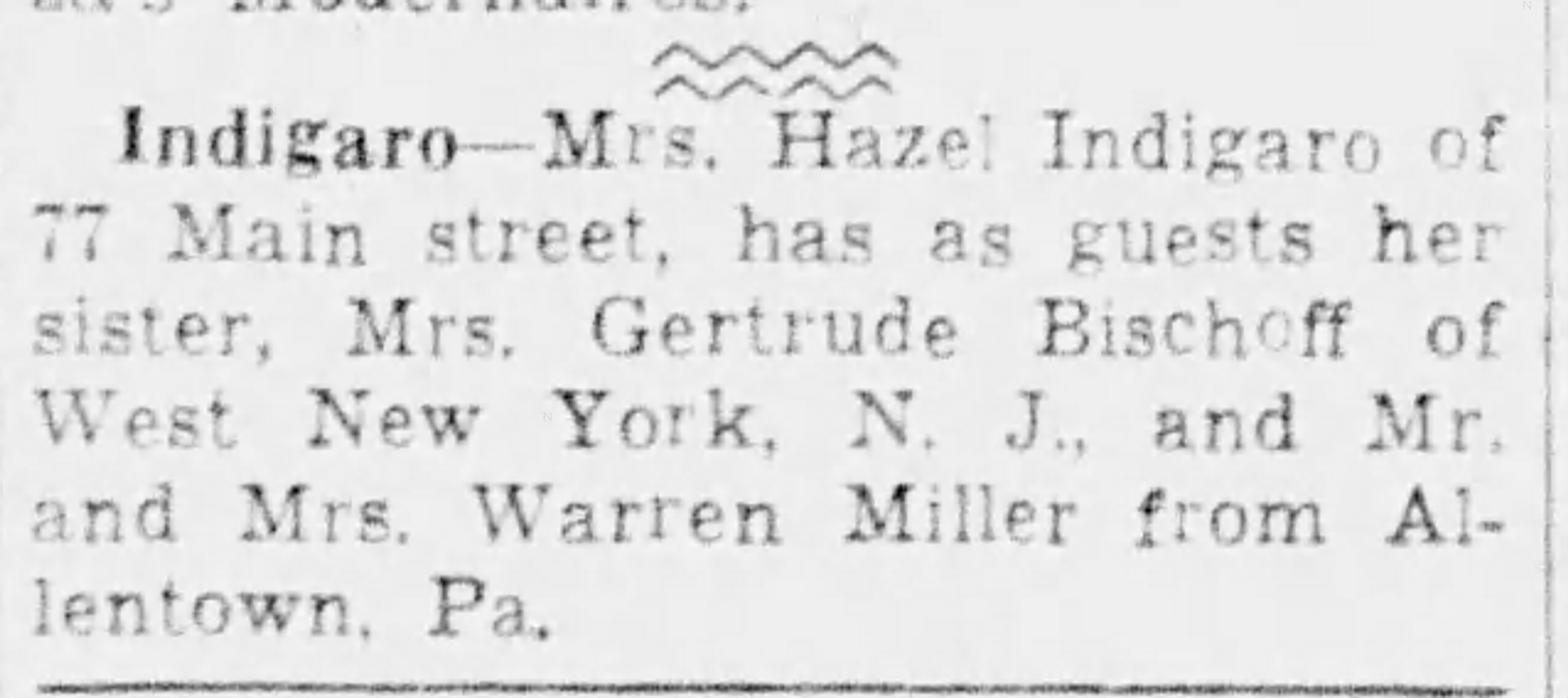
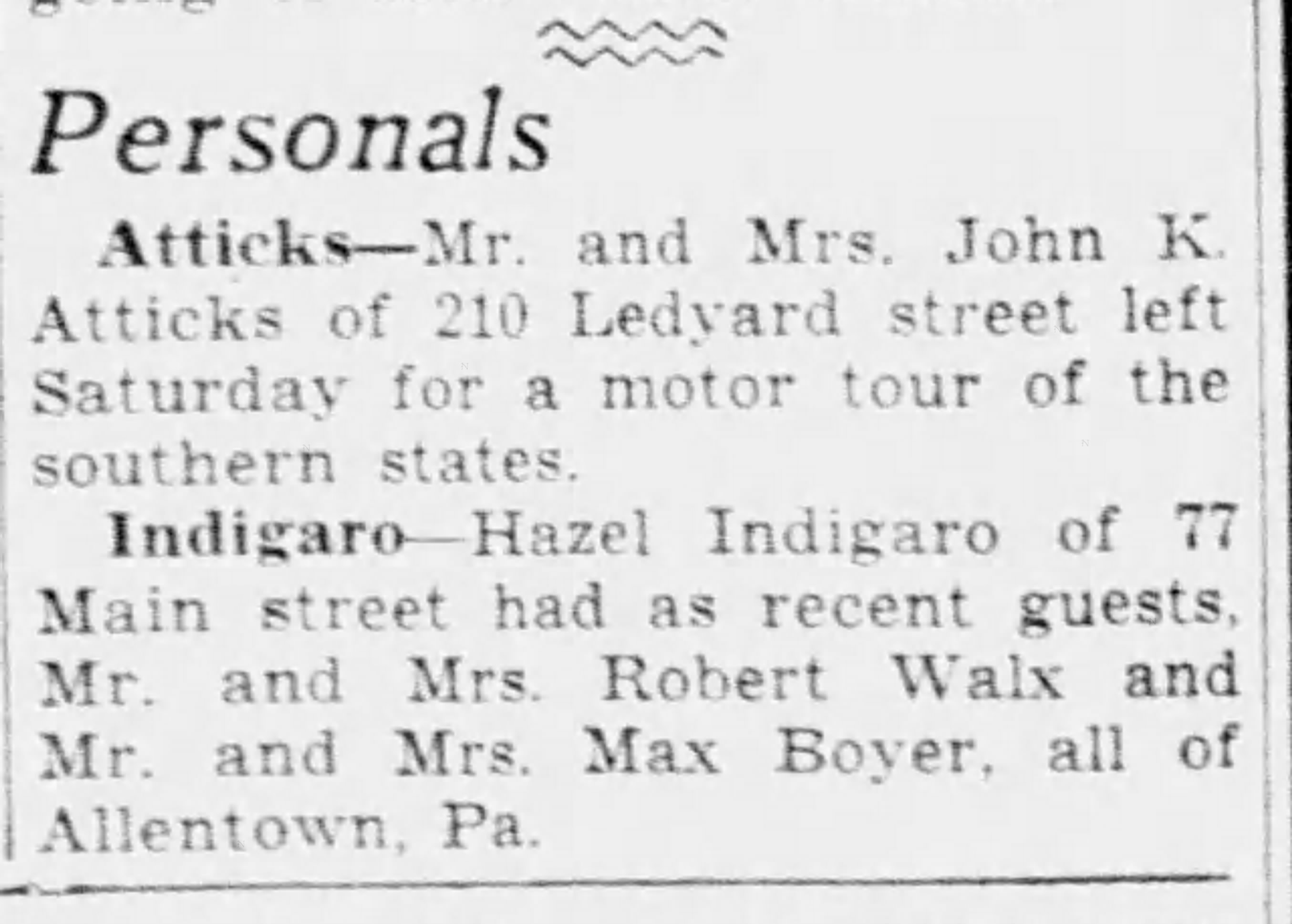
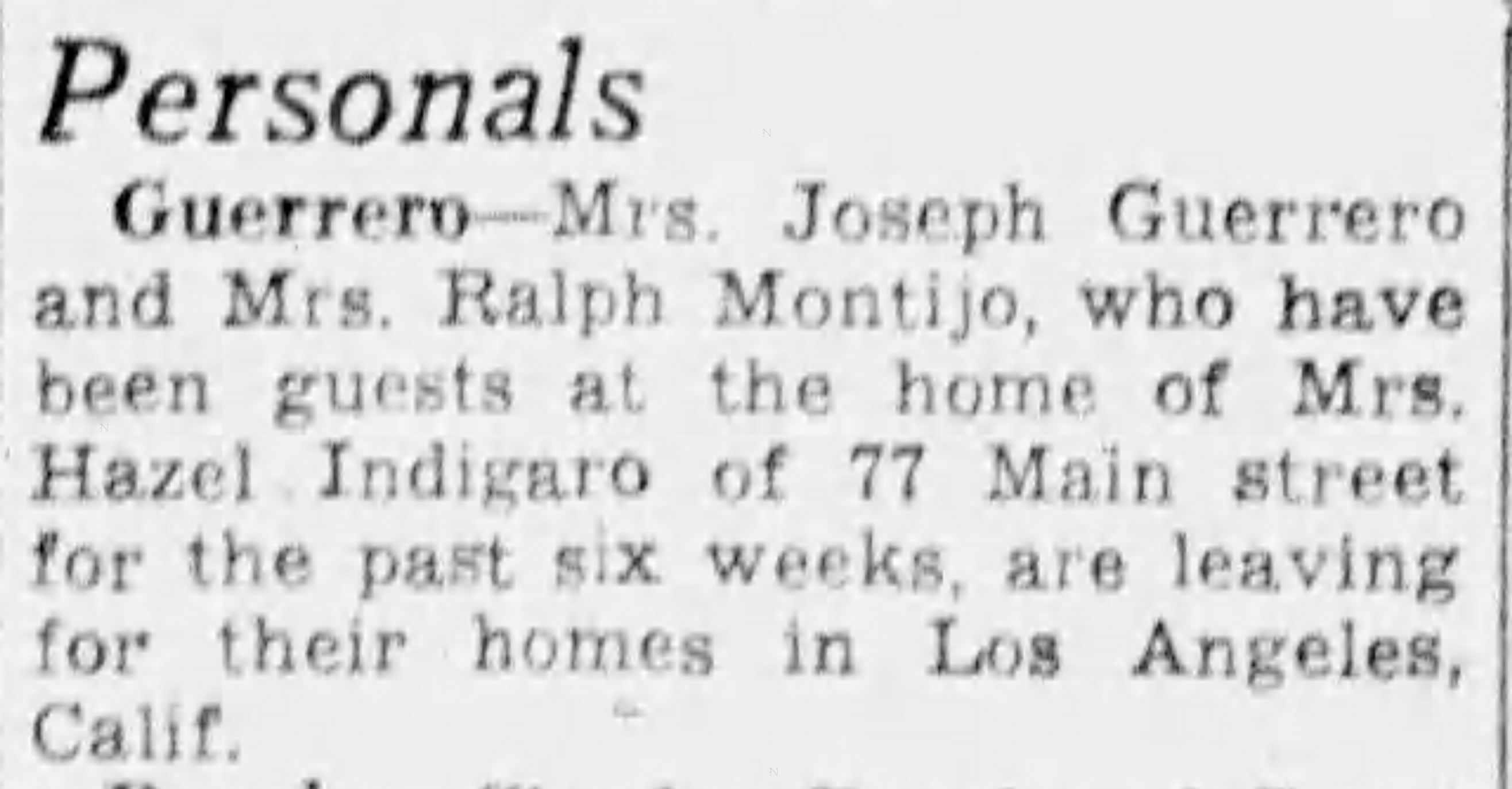
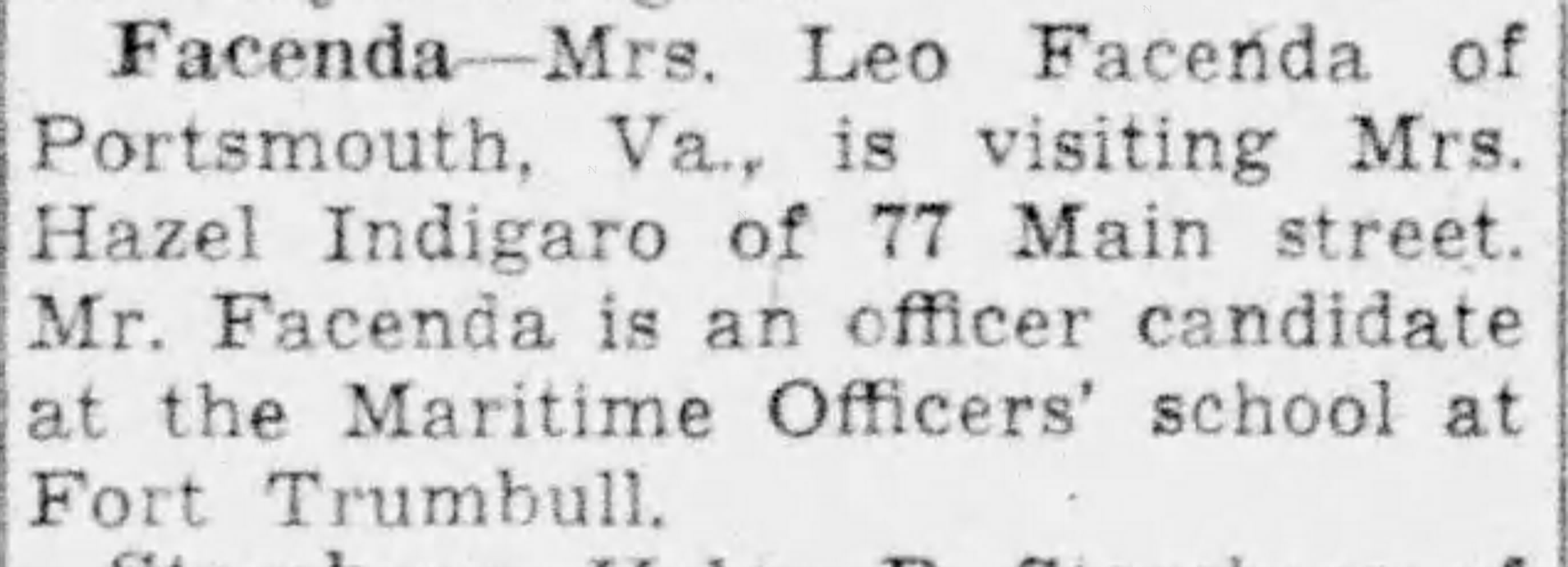
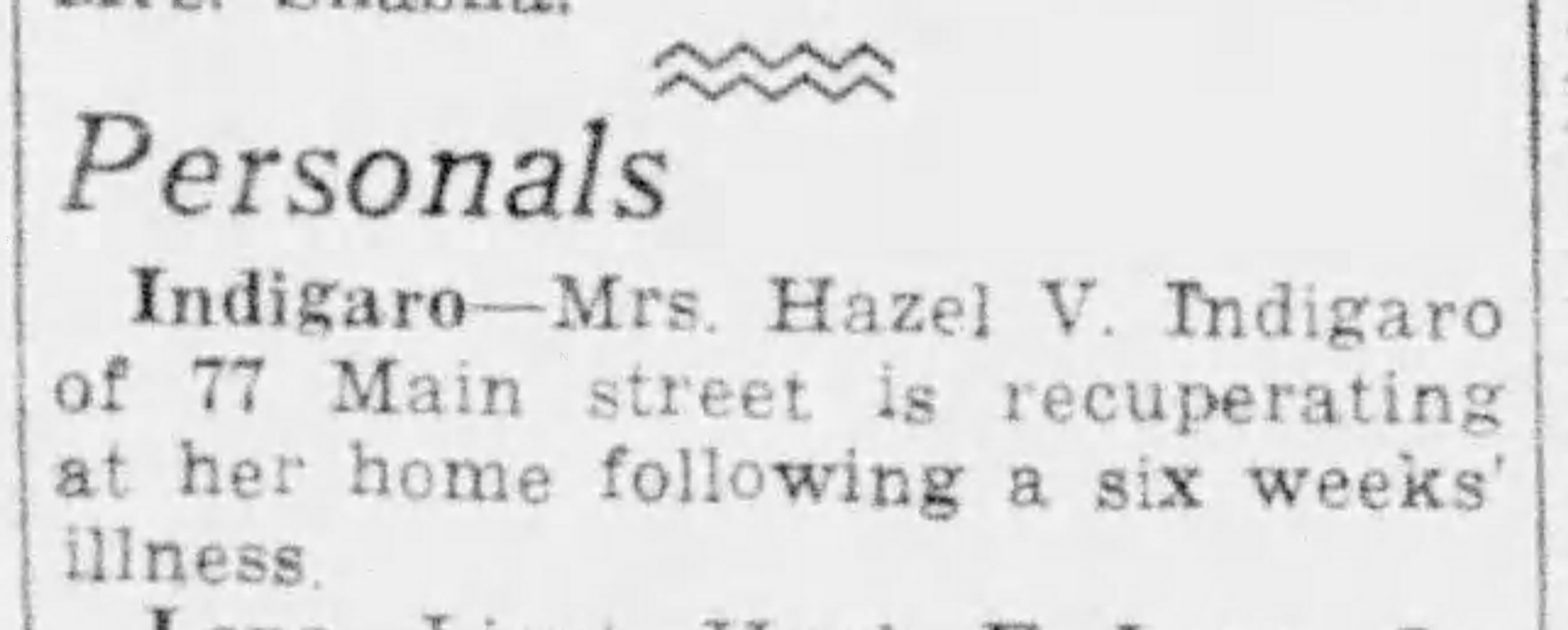
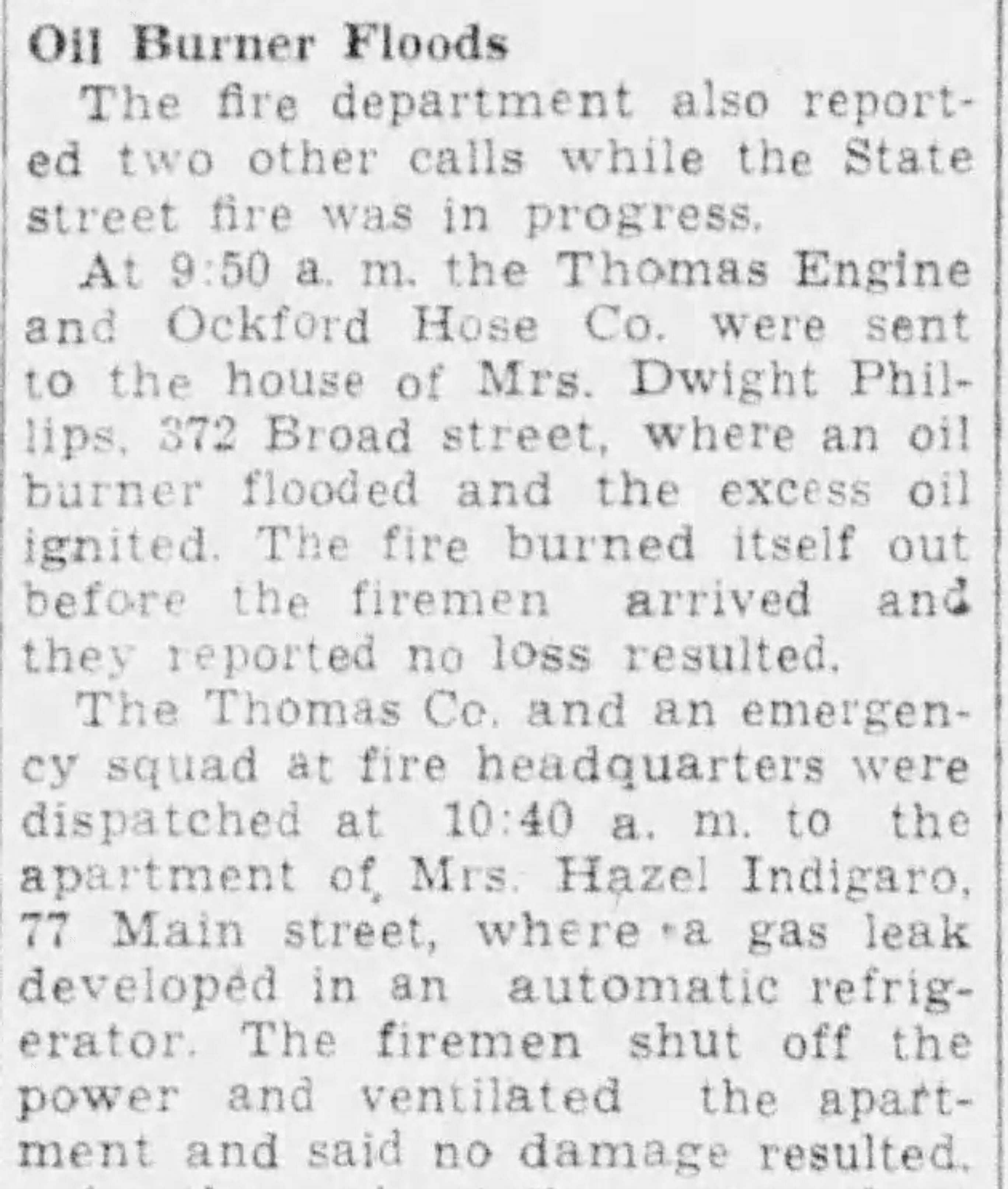
While Edward served at sea, Hazel V. Indigaro maintained the household at 77 Main Street, New London. The society and personal columns of The Day offer a remarkably detailed window into her daily life — guests from out of town, a winter trip to Florida, a six-week illness, and a gas leak that brought the fire department to her door.
Sources & Research Notes
This biography was compiled from U.S. Navy muster rolls, personnel records, census records, voter registration documents, contemporary newspaper accounts, and oral history provided by family members.
Naval Records
U.S. Navy muster rolls and Proof of Strength documents · Report of Changes records · Bureau of Naval Personnel retirement orders · Fleet Reserve transfer documentation
Census & Civil Records
U.S. Census records (1910–1950) · Voter registration records, Los Angeles County, 1956 · Marriage record, New London, Connecticut, July 14, 1942
Newspaper Accounts
New London newspaper notices (1949–1951) · Reckless-driving arrest and fine, August 1950 · Automobile collision account, 1973 · Christmas holiday notice identifying Edward as chief boatswain's mate, U.S.N.
Oral History
Evelyn Ann Indigaro (granddaughter of Thomas Indigaro) — family recollections of Edward's personality, physical appearance, humor, generosity, devotion to family, enjoyment of Santa Anita Park, and habit of hiding savings in pies · Family recollection of the "old guys" story involving the decommissioning of an unidentified ship
Chief Boatswain's Mate Edward Dominic Indigaro
United States Navy · 1929–1959
He entered the Navy in 1929 and gave it thirty years. The records preserved his service. His family preserved Eddy.
Research Disclaimer: The biography and historical narrative presented on this page are based on publicly available records, documents, and information provided at the time of research. While every effort has been made to ensure accuracy, The Last Watch Project cannot guarantee that all details are complete or entirely correct. Records may be incomplete, transcribed with errors, or subject to differing interpretations. This biography represents our best understanding of the veteran's life based on available evidence and should be regarded as an informed reconstruction, not a definitive historical record.